About Cordyline indivisa (G.Forst.) Endl.
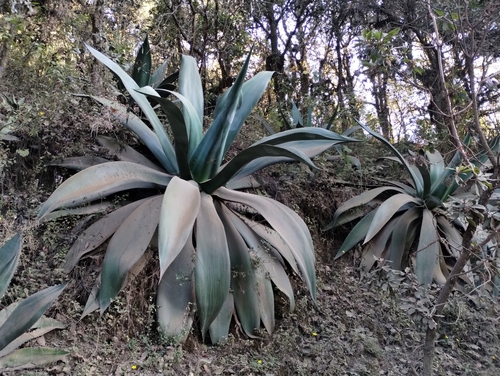
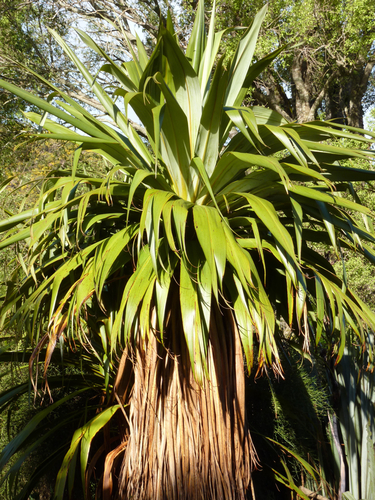
Cordyline indivisa (G.Forst.) Endl. is a very distinctive species of Cordyline. It can be told apart from all other Cordyline species by its very broad blue-grey leaves, and its smaller, tightly compacted inflorescence that grows from beneath the foliage. It grows as a stout tree reaching up to 8 metres (26 ft) tall, with a trunk measuring 40–80 centimetres (1 ft 4 in – 2 ft 7 in) in diameter. Its stem is usually unbranched, or has very few branches. The leaves are 1–2 metres (3 ft 3 in – 6 ft 7 in) long, and 10–30 centimetres (3.9–11.8 in) wide. As the foliage ages, it droops; it is blue-green, shaped like a broad sword, and has a broad, conspicuous midrib that is often tinted red, orange red or golden. Its inflorescence is a panicle that grows from the base of the growing points underneath the leaves. In New Zealand's North Island, Cordyline indivisa occurs south of Kohukohunui in the Hunua Ranges and Te Moehau (Coromandel Peninsula), but only becomes common south of the Raukūmara Ranges and the central Volcanic Plateau. In the South Island, it is widespread and common across the northern and western portions of the island, and occurs more locally in the drier eastern regions. In traditional Māori culture, the fronds of Cordyline indivisa were highly valued for traditional weaving. They were used as fibre to make rain capes, and are better suited for this purpose than fronds from other Cordyline species because of this plant's wider leaves. Cordyline indivisa is a very attractive tree, but it tends to collapse suddenly during periods of high temperatures or water shortage. It prefers cool moist soils and semi-shade, and grows easily in the cooler parts of New Zealand. North of Hamilton, it can only be grown with great difficulty, and few plants survive long enough to flower in lowland areas.