About Cordyline fruticosa (L.) A.Chev.
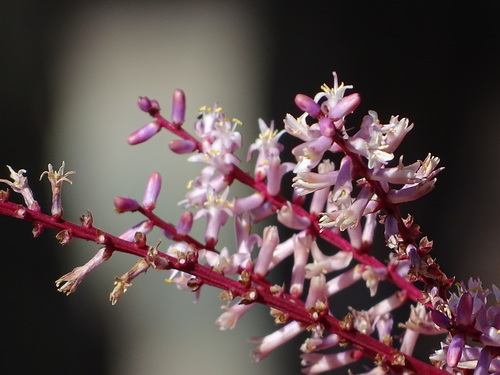
Cordyline fruticosa (L.) A.Chev. is a palm-like, woody plant that grows up to 4.5 metres (15 feet) tall. It has a slender woody trunk topped with an attractive fan-like, spirally arranged cluster of broadly elongated leaves. The leaves range in color from red to green, and variegated forms also exist. Mature leaves at the top of the stem are typically 30–60 centimetres (12–24 inches) long, rarely reaching 75 cm (30 in), and 5–10 cm (2–4 in) wide. It produces 40–60 cm (16–24 in) long panicles of small, scented yellowish to red flowers, which mature into red berries. The original native distribution of this species is unknown, but it is thought to be native to the region spanning from Bangladesh to Mainland Southeast Asia, South China, Taiwan, Maritime Southeast Asia, New Guinea, and Northern Australia. It has the highest morphological diversity in New Guinea, and is believed to have been extensively cultivated there. Austronesian peoples carried the plant throughout Oceania, reaching as far as Hawaii, New Zealand (including the Kermadec Islands), and Easter Island at their furthest extent. A particularly important type of ti in eastern Polynesia is a large green-leafed cultivar grown for its enlarged edible rhizomes. Unlike ti populations in Southeast Asia and Near Oceania, this cultivar is almost entirely sterile in the further islands of eastern Polynesia, and can only be propagated by cuttings taken from stalks or rhizomes. This sterility is speculated to be the result of deliberate artificial selection, likely because the cultivar produces larger, less fibrous rhizomes that are more suitable for use as food. It was introduced to Europe as a houseplant in 1771. Its roots and young leaves can be cooked and eaten as survival food, and its leaves can be made into a rain cloak. In the Philippines, the roots were used to flavor traditional intus sugarcane wines made by the Lumad people of Mindanao. In Polynesia, leaves of the green-leafed form are used to wrap food, and line earth ovens and breadfruit fermentation pits. Rhizomes of the green-leafed form are harvested and processed into a sweet molasses-like pulp eaten like candy, or processed into a honey-like liquid used for various sweet treats. In Hawaii, roots mixed with water and fermented are distilled into an alcoholic beverage called okolehao. Fibers extracted from the leaves are used for cordage and to make bird traps. Throughout Austronesia and New Guinea, the plant is widely used for traditional medicine, dye, and ornamentation. Its flowers are a traditional treatment for asthma, and their anthocyanin content has been assessed to examine their potential use as a commercial herbal remedy. Cordyline fruticosa is a popular ornamental plant, with numerous cultivars available, many selected for green, reddish, or purple foliage.