About Cordyline cannifolia R.Br.
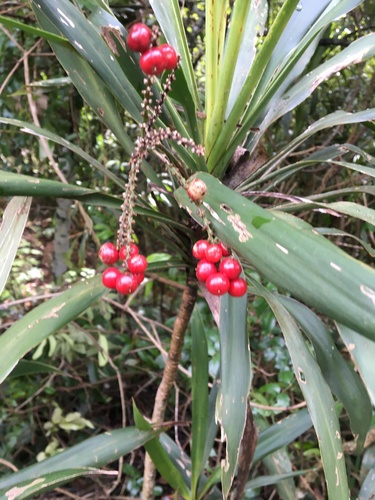
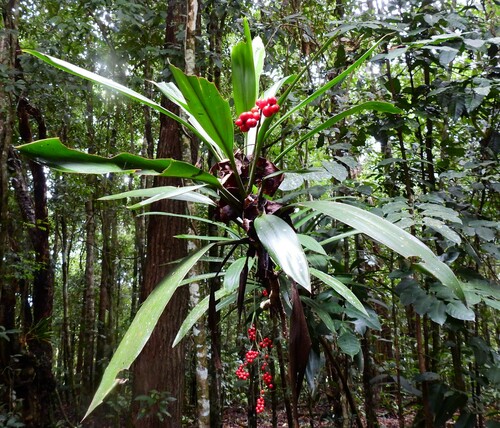
Cordyline cannifolia R.Br. is an open, erect shrub that is most often single-stemmed. It typically grows to around 3 m (9.8 ft) tall, though it can reach a maximum height of 5 m (16 ft). Its stem and branches have numerous scars from former leaf attachments. Large, simple leaves grow in an alternate arrangement toward the ends of the stem and branches. The upper surface of the leaves is mid green, while the underside is a matte blue-green (glaucous) with clearly visible numerous secondary veins. Leaves are between 20 and 50 cm (8 and 20 in) long and 5 to 12 cm (2.0 to 4.7 in) wide, and grow from a petiole that ranges from 5 to 20 cm (2 to 8 in) long. The upper side of the petiole is grooved, often deeply enough to form a U-shaped cross section; its base clasps the stem and overlaps the petiole base of the younger leaf growing above it. The plant's inflorescence is a panicle up to 25 cm (10 in) long, which holds many flowers each attached by a short stalk around 2 mm (0.08 in) long. Each flower has five petals approximately 7 mm (0.28 in) long, five stamens, and one style. The fruit is botanically classified as a berry, is red in color, measures around 1 cm (0.4 in) in diameter, and contains up to six small black seeds. This species has been collected along almost the entire east coast of Queensland, from the northern tip of Cape York Peninsula south to K'gari (Fraser Island), though most collections come from the Wet Tropics bioregion around Cairns. It also grows in the northeastern Northern Territory, and there is one single collection record for Papua New Guinea listed in GBIF. The Papua New Guinea record is considered doubtful. Cordyline cannifolia grows in rainforest and wet sclerophyll forest, at altitudes ranging from sea level up to around 1,200 m (3,900 ft). Cassowaries and native rodents eat the fruit of this plant.