About Cordyla africana Lour.
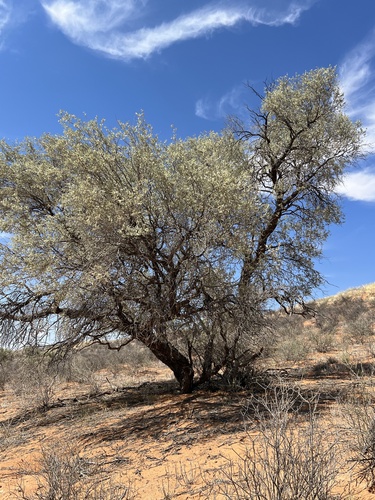
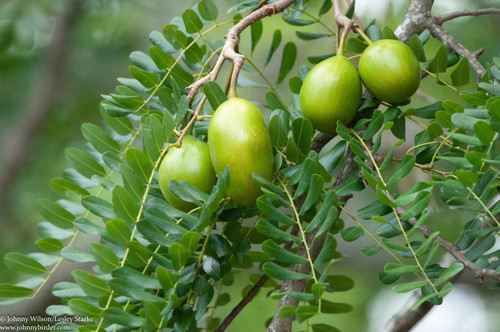
Cordyla africana Lour. is a species of flowering plant in the legume family Fabaceae. It is a deciduous tree native to Africa, growing up to 25 meters (82 feet) tall. It has a large, spreading, heavily branched crown, and a trunk with a diameter at breast height of around 2.2 meters (7 feet 3 inches). It is commonly known as wild mango. This species grows at elevations up to 1,000 meters (3,300 feet) in large river valleys, miombo woodland, and coastal swampy evergreen forest, most often on sandy soils, along the eastern parts of central and southern Africa. Its confirmed distribution includes KwaZulu-Natal and Mpumalanga provinces in South Africa, Kruger National Park, Eswatini, Mozambique, Zimbabwe, Zambia, Malawi, Kenya, and Tanzania. The genus name Cordyla comes from the Greek word kordyle, meaning 'club', which refers to the species' club-shaped fruit and stalk. Mature bark of the tree is rough, dark brown, and fissured; a cut into the bark reveals a yellow blaze marked with orange streaks. The flowers have no petals, and bear yellow to orange stamens arranged in axillary racemes that grow up to 50 mm (2.0 in) long, holding up to 12 flowers per raceme. Flowers emerge alongside new leaves in September. Like the flowers of Schotia, these flowers face upward and are filled with nectar, attracting a wide variety of birds. Unusually for members of the legume family, the fruit starts as a standard young pod before developing into an indehiscent, glossy, golden-yellow ovoid fruit up to 80 mm (3.1 in) long, attached to a thick stalk. When fully mature, the fruit has a soft, thin skin with a slight depression on one side. Fruits fall from the tree before they are fully ripe, and complete ripening on the ground. One to eight large brown seeds are enclosed in yellow, sticky pulp, and the seeds often germinate directly from within the fallen fruit. The fruit is rich in vitamin C and is sought after by many mammals, including elephants. When backlit, leaflets show transparent gland dots and streaks. If damaged, twigs and unripe green fruit exude latex. The species was first formally described from Portuguese East Africa by João de Loureiro (1710–1791), a Jesuit priest, missionary who worked in Goa, Macao, and Cochin China, and a practicing naturalist and mathematician. Eight species of the genus Cordyla are currently recognized, all restricted to eastern Africa and the island of Madagascar.