About Corchorus capsularis L.
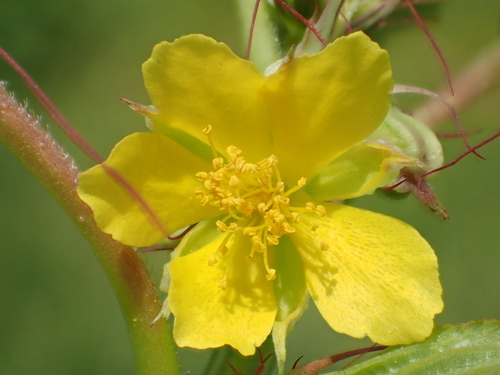
Corchorus capsularis L. is an erect annual shrub that grows to 2 meters or more in height. It has acute leaves, yellow five-petaled flowers, and globular fruits. It most likely originated in China, and is currently cultivated in Bangladesh, India, and the Amazon region of Brazil, while also being found naturalized across much of tropical Africa.
Corchorus capsularis, along with Corchorus olitorius, is one of the main sources of jute. The fiber produced from C. capsularis is whiter and considered higher quality than fiber from C. olitorius. Fiber is extracted from cut stems through water retting, after which soft tissue is removed, and the fiber is cured and dried. This fiber is used to make sacks, bags, carpets, curtains, fabrics, and paper. Global jute production is concentrated in India and Bangladesh, where the crop grows well in the floodplains and delta of the Ganges and Brahmaputra rivers.
Young leaves and shoots of this plant are widely eaten in salads, while older leaves and shoots are cooked and eaten as a leafy vegetable. Dried, powdered leaves are used to thicken soups or to make tea. Immature fruits of the plant are also eaten, either raw or cooked.
This plant is also used in herbal medicine. Its leaves have been used to increase appetite, aid digestion, act as a laxative, and act as a stimulant. An infusion made from the leaves has been used to reduce fever, and both the roots and leaves have been used to treat dysentery. The seeds contain a digoxin-like substance and are poisonous to both animals and insects.