About Coragyps atratus (Bechstein, 1793)
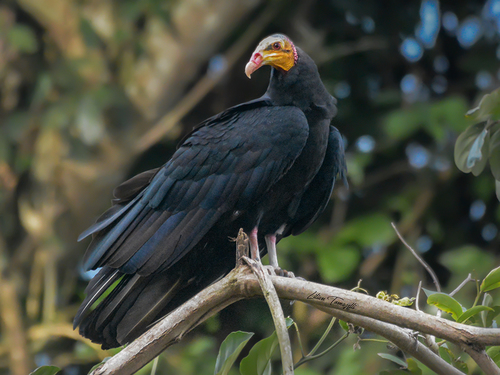
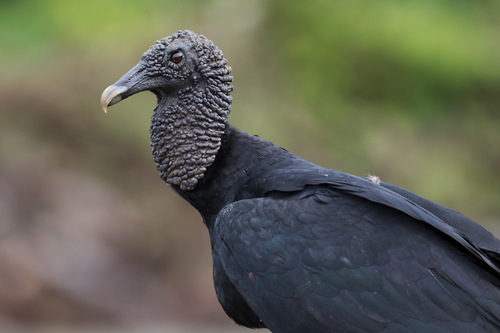
Coragyps atratus, commonly called the black vulture, is a fairly large scavenging bird. Adults measure 56–74 cm (22–29 in) in total length, with a wingspan ranging from 1.33–1.67 m (52–66 in). Body weight varies by region: black vultures from North America and the Andes weigh between 1.6 and 3 kg (3.5 to 6.6 lb), while smaller individuals from tropical lowlands weigh 1.18–1.94 kg (2.6–4.3 lb). A sample of 50 vultures from Texas had an average weight of 2.15 kg (4.7 lb), and a sample of 119 birds from Venezuela averaged 1.64 kg (3.6 lb). Measured body part dimensions include an extended wing bone of 38.6–45 cm (15.2–17.7 in), a moderately short tail of 16–21 cm (6.3–8.3 in), and a relatively long tarsus of 7–8.5 cm (2.8–3.3 in). The species' plumage is primarily glossy black. Its head and neck are featherless, covered in dark gray, wrinkled skin. The iris is brown, with one incomplete row of eyelashes on the upper eyelid and two rows on the lower eyelid. Legs are grayish-white; the two front toes of the foot are long and have small webs at their bases. The nostrils are perforate, not separated by a septum, meaning it is possible to see through the beak from the side. Black vultures have broad but relatively short wings. The bases of the primary feathers are white, creating a visible white patch on the underside of the wing edge when the bird is in flight. The tail is short and square, barely extending past the edge of the folded wings. A leucistic subspecies C. atratus brasiliensis was observed in Piñas, Ecuador in 2005. This individual had mostly white plumage, with only black coloration on the tarsus, tail, and some undertail feathers. It was not an albino, as its skin had a typical dark color, and it was found in a flock of around 20 normally plumaged black vultures. The black vulture has a distribution spanning the Nearctic and Neotropic realms. Its native range includes the mid-Atlantic United States, the southernmost parts of the U.S. Midwest, the southern United States, Mexico, Central America, and most of South America. In the 21st century, the species' range has expanded further north into the U.S. Midwest and northeastern United States. Black vultures are generally permanent residents across their range, though individuals at the extreme northern edge of the range may migrate short distances, and other populations may make local movements during unfavorable conditions. In South America, the range extends to Peru, central Chile, Uruguay, and Brazil. It also occurs as a vagrant on Caribbean islands. The species prefers open landscapes mixed with patches of woodland or brush, but can also be found in moist lowland forests, shrublands, grasslands, wetlands and swamps, pastures, and heavily degraded former forests. Individuals are most often seen soaring or perched on fence posts or dead trees. When searching for food, the black vulture soars at height, holding its wings horizontally when gliding. Its flight pattern consists of short bursts of flapping followed by short gliding periods. Its flight is less efficient than that of other vultures, because its shorter wings create a smaller total wing area. Compared to the turkey vulture, the black vulture flaps its wings more often during flight. When approached or disturbed, black vultures are known to regurgitate, which helps deter predators and reduces takeoff weight to make flight easier. Like all New World vultures, the black vulture frequently defecates on its legs, using evaporation of water from feces and/or urine to cool its body through a process called urohidrosis. This cools the blood vessels in the unfeathered tarsi and feet, and leaves streaks of white uric acid on the legs. Like other New World vultures, the black vulture lacks a syrinx, so it has very limited ability to produce vocalizations. It is generally silent, but can make hissing and grunting sounds when agitated or feeding. The black vulture is a gregarious species that roosts in large groups. In areas where their ranges overlap, black vultures will roost on the bare branches of dead trees alongside groups of turkey vultures. Black vultures typically forage in groups, and a flock can easily displace a foraging solitary turkey vulture from a carcass. Like the turkey vulture, black vultures are often seen standing with their wings spread. This posture is thought to serve multiple purposes: drying the wings, warming the body, and killing bacteria. This behavior is also seen in other New World vultures, Old World vultures, and storks. There are multiple recorded instances of black vultures approaching and preening crested caracaras. In every recorded case, this unusual interaction starts with the crested caracara bending its head down, in what appears to be an invitation to preen.