About Copsychus saularis (Linnaeus, 1758)
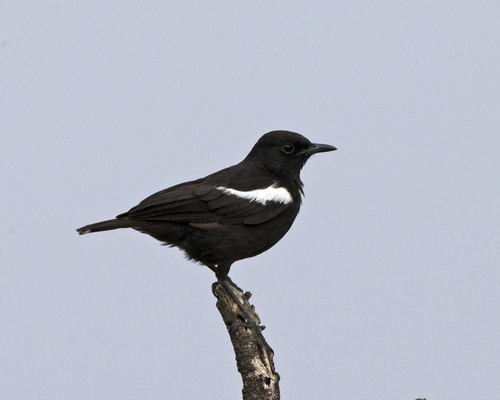
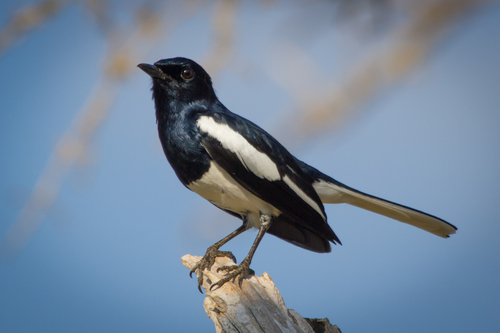
This species, Copsychus saularis, measures 19 centimetres (7.5 inches) long including its long tail, which is typically held cocked upright when the bird hops on the ground. The tail is held in the normal position seen in other birds when the birds are singing. It is similar in shape to the smaller European robin, but has a longer tail. Males have black upperparts, head, and throat, with the exception of a white shoulder patch. Their underparts and the sides of the long tail are white. Females have greyish black upperparts and greyish white underparts. Young birds have scaly brown upperparts and head. The nominate race occurs on the Indian subcontinent, and the females of this race are the palest. Females of the Andaman Islands race andamanensis are darker, have heavier bills, and shorter tails. For the Sri Lankan race ceylonensis, which was formerly grouped with peninsular Indian populations south of the Kaveri River, and southern nominate individuals, females are nearly identical to males in plumage shade. Eastern populations from Bangladesh and Bhutan have more black on the tail and were formerly named erimelas. Populations in Myanmar (Burma) and further south are classified as the race musicus. A number of other named races exist across the species’ range, including prosthopellus (Hong Kong), nesiotes, zacnecus, nesiarchus, masculus, pagiensis, javensis, problematicus, amoenus, adamsi, pluto, deuteronymus and mindanensis. However, many of these races are not well-marked, and the status of some of them is disputed. Some, like mindanensis, are now usually recognized as a full species, the Philippine magpie-robin. There is more geographic variation in female plumage than in male plumage. This species is mostly seen close to the ground, hopping along branches or foraging in leaf litter on the ground with a cocked tail. During the breeding season, males sing loudly from the tops of trees or other high perches. This magpie-robin is a resident breeder in tropical southern Asia, found across Nepal, Bangladesh, India, Sri Lanka, eastern Pakistan, eastern Indonesia, Thailand, south China, Malaysia, and Singapore. The Oriental magpie-robin occurs in open woodland and cultivated areas, often close to human habitations. Magpie-robins breed mainly from March to July in India, and from January to June in south-east Asia. Males sing from high perches during courtship. Male courtship display involves puffing up feathers, raising the bill, fanning the tail, and strutting. They nest in tree hollows or niches in walls or buildings, and often make use of nest boxes. They line the nesting cavity with grass. The female handles most of the nest building work, which is completed about a week before eggs are laid. Four or five eggs are laid at 24-hour intervals; the eggs are oval, usually pale blue green with brownish speckles that match the color of hay. Eggs are incubated by the female alone for 8 to 14 days. Nests are reported to have a characteristic odour. Females put more effort into feeding young than males. Males are quite aggressive during the breeding season and will defend their territory. They respond to the singing of intruders, and even to their own reflections. Males spend more time on nest defense. Studies of this species’ birdsong show that dialects exist, with neighbouring populations having differing songs. Calls of many other bird species may be imitated as part of this species’ song. This pattern may indicate that the birds disperse and are not philopatric. Females may sing briefly when in the presence of a male. Apart from song, they use a range of different calls: territorial calls, emergence and roosting calls, threat calls, submissive calls, begging calls, and distress calls. Their typical mobbing call is a harsh hissing krshhh. The diet of magpie-robins mainly consists of insects and other invertebrates. Although they are primarily insectivorous, they are known to occasionally consume flower nectar, geckos, leeches, centipedes, and even fish. They are often active late into dusk. They sometimes bathe in rainwater that has collected on tree leaves.