About Coprosma rotundifolia A.Cunn.
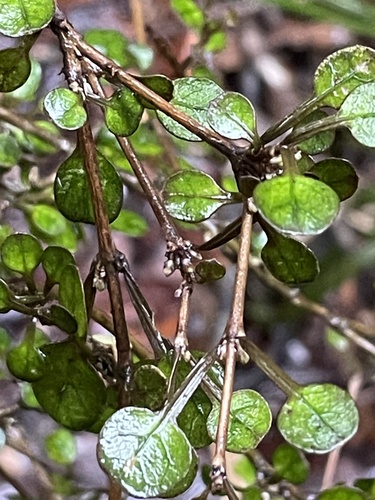
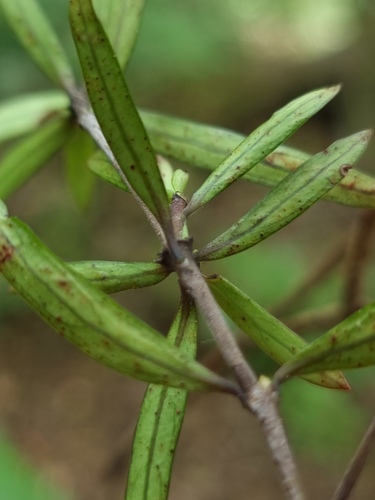
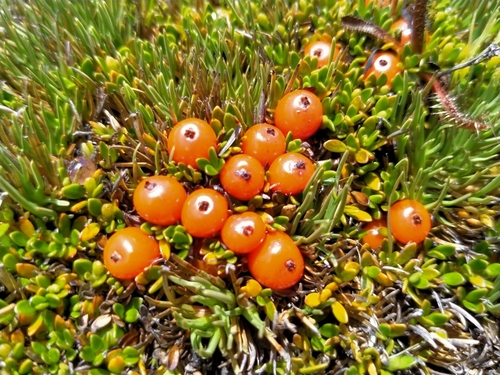
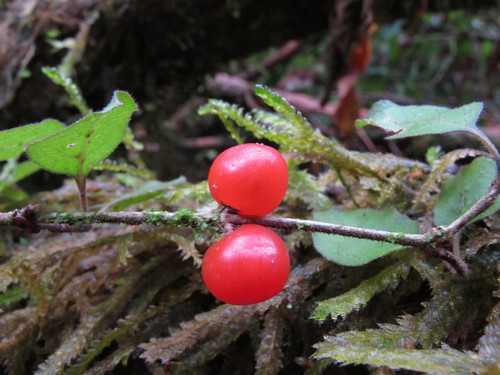
Coprosma rotundifolia A.Cunn. is a bushy shrub that can grow up to 6 metres (20 ft) tall. It has small, wide-angled divaricated branches. Its leaves are small, tapered, opposite one another, and measure 15–25 millimetres (0.59–0.98 in) long by 10–20 millimetres (0.39–0.79 in) wide, ending in a sharp tip. A small, tooth-like stipule with a blunt, rounded base sits below the leaf stalk at the base of each leaf. Most leaves are pale green, often marked with purple blotches, and covered in short to long soft hairs, especially along the leaf edges. The leaf blade is very thin, with visible veins on both leaf surfaces. Domatia are found on the lower leaf surface, between veins, along the midrib, and near leaf edges. This species produces orange to red, 4–5 millimetre (0.16–0.20 in) diameter fruit that grows on short separate branches that do not support foliage. Flowers grow in clusters between September and November. There are around 60 Coprosma species found in New Zealand; C. rotundifolia is distributed from Kaitaia south through the North Island, and across the entire South Island and Stewart Island. It grows from lowland to montane habitats, especially on alluvial soils and in damp lowland forests, and it is most common in riparian forest and scrubland. It has also been planted as a horticultural plant, so it may now be found in a wide range of habitats. Cultivated plants are hardy, fast-growing, low-maintenance, and require winter pruning. They are typically grown in ornamental gardens for their unique form. C. rotundifolia grows best in moist, well-drained, fertile soil, and also thrives in calcium carbonate-rich soils such as limestone-rich soils. Flowers form in axillary clusters of 2–4 between September and November, with female and male flowers produced on separate individual plants. Male flowers have no calyx. The corolla is funnel-shaped, with lobes that are widest at the base, ovate, and end in a sharp tip farthest from the corolla tube. The fruit is a globe-shaped drupe 4–5 mm in diameter, orange to red, and contains two seeds. Birds that eat the fruit are the main disperser of the seeds. Seeds germinate in favourable conditions including soils with higher calcium carbonate levels, and can grow into a small tree.