About Coprosma robusta Raoul
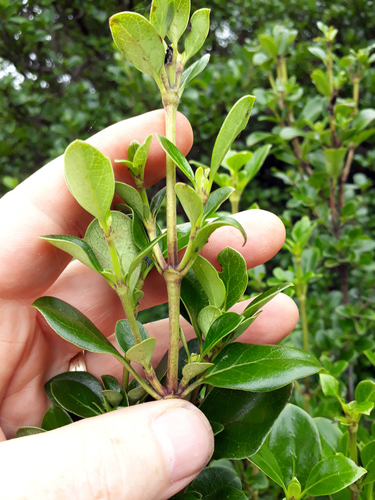
Karamū (Coprosma robusta Raoul) is a large, bushy shrub that grows up to 6 meters (20 feet) tall. It has stout, hairless branches. Domatia (small structures on the underside of leaves where veins intersect) and stipules are defining characteristic features of all Coprosma species. Karamū’s stipules are black, hairless, and obtuse, with slightly serrated margins, and are united at their base.
Karamū is endemic to New Zealand. It has gradually become naturalised along the south-east coast of Australia, in areas including Victoria and Tasmania, where it is classified as a weed threat. It is widely distributed across both the North and South Islands of New Zealand. A small naturalised population of karamū grows between Waitangi and Owenga on the Chatham Islands. The species naturally occurs most often in lowland forest. According to distribution data from New Zealand Plant Observation, karamū abundance increases at lower altitudes, meaning more plants are found in the North Island. In the Canterbury region, karamū grows on Banks Peninsula in fragments of regenerating native bush and remaining bush remnants. It also occurs along forest margins and edges of montane and lowland forests at the start of the Canterbury Plains, near the Southern Alps. Karamū can also be found in urban green spaces across Christchurch, including Riccarton Bush.
Karamū is widely found in coastal, lowland, and lower montane areas. It also grows in shrublands and open areas within dense forest, particularly lowland forest. Its population decreases in lowland beech and kahikatea forests. Karamū is a hardy plant that can adapt to infertile soils, poorly drained sites, and exposed landscapes. It can grow at altitudes ranging from 0 to 1,200 meters (0 to 3,937 feet), and tolerates conditions from full sun to full shade, as well as windy and frosty environments.
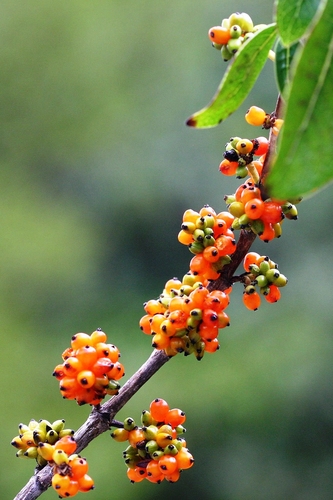
In New Zealand, karamū flowers from winter (starting around July) through to summer (ending around December). It is dioecious, meaning male and female flowers grow on separate individual plants. Seeds mature by around April and begin germinating soon after they mature; the species does not form a long-lasting seed bank. Seeds are mostly dispersed by birds that eat the plant’s fruit. Thanks to its hardy traits, karamū grows easily from seed even on open sites. Karamū’s fruiting season peaks between April and May. It grows to a maximum height of six meters, and typically acts as a secondary succession plant during ecological community development.
Karamū is used in traditional Māori Rongoā medicinal practices. Boiled liquid from juvenile shoots is drunk to reduce inflammation and treat bladder problems. Māori traditionally use karamū leaves to treat kidney issues, and the bark to treat stomachache and vomiting.
Mature karamū berries are a traditional Māori food, and karamū leaves are used to line hāngī pits to add flavor to cooked food. The berries have a bitter-sweet taste, and flavor varies widely between individual plants.
Early European settlers in New Zealand used boiled karamū leaves as a substitute for tea. In 1877, Coutts Crawford tested karamū berries as a potential ingredient to make coffee.