About Coprosma rhamnoides A.Cunn.
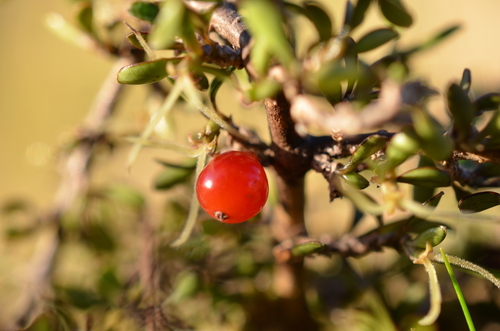
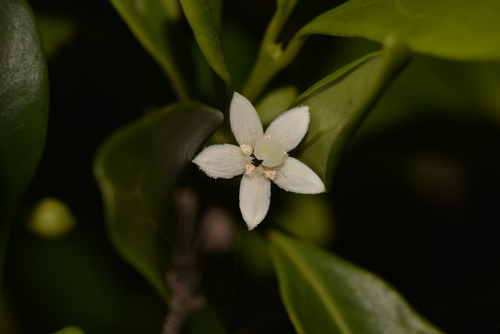
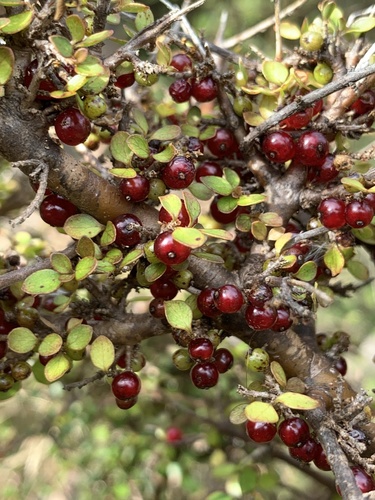
Coprosma rhamnoides A.Cunn., commonly called twiggy coprosma, is a dense shrub that often sprawls over rocks, and typically grows less than 1 metre tall. It has numerous thin, rigid, divaricating branches that grow in many directions, reaching around 10 mm in diameter. This abundant branching creates a distinct twiggy appearance that gives the species its common name. The bark is reddish brown; when scratched, it reveals a yellow-green inner layer. Its leaves are opposite, often arranged in bundles, with very short pubescent petioles, and range from 7 to 12 mm long. Leaf size and shape vary based on maturity; the most common broad form of leaf is orbicular. Leaves narrow quickly into their petioles, and hairs from the petiole extend onto the lower leaf surface. Leaf blades are leathery, matte, and glabrous on the upper surface; the underside shows a reticulate pattern and may also be pubescent. The almost microscopic stipules at the base of the leaves are pubescent, and have a sharp denticle at their tips. Small flowers grow in leaf axils. Both male and female flowers have four-lobed corollas: male corollas are 2.7 mm long, and bear four stamens; female corollas are 1.3 mm long, narrower, and funnel-shaped. This species produces fleshy, globose crimson or ruby red berries that grow singly along branchlets. Coprosma rhamnoides is endemic to New Zealand. It is common throughout most of the country, but is not found in Otago, Southland, or Fiordland. It prefers lowland habitats, including lower mountain ranges, at forest edges and in shrubland. It frequently grows as understorey vegetation beneath Leptospermum (mānuka) and Kunzea (kānuka). The species produces small seeds surrounded by fleshy red berries. Seedlings begin to emerge two to three months after germination. Mature shrubs produce small flowers in spring, from September to October. Flowers are wind pollinated. Flowers develop into small green berries in November, which ripen to red by June of the following year. Ripe berries can remain on the shrub, over-ripening and turning crimson or black.