About Coprosma lucida J.R.Forst. & G.Forst.
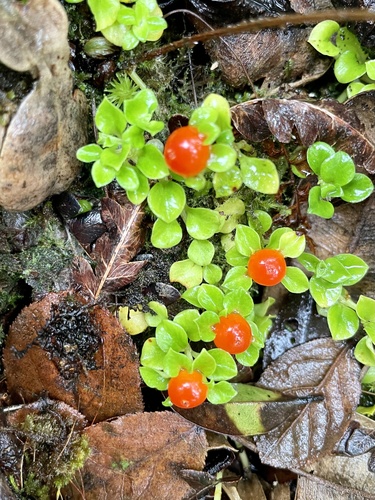
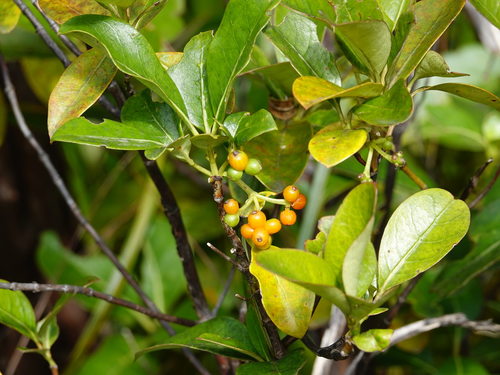
Coprosma lucida J.R.Forst. & G.Forst. typically grows as a shrub or tree, reaching a maximum height of 5 to 6 metres. It is a large-leaved Coprosma species compared to other members of the genus. Its leaves are dark green on the upper surface and paler green underneath, with sometimes undulating margins. Fully grown leaves are typically 12 to 17 cm long, 3 to 5 cm wide at their widest point, and elliptical in shape, tapering toward both the leaf tip and the base where the leaf connects to the petiole. The petiole, which links the leaf to the stem, is 1–3 cm long on average. Between each pair of opposite petioles is a short, triangular green stipule. This green solid stipule distinguishes C. lucida from the similar, often co-occurring Coprosma robusta, which has a black-tipped stipule. The leaf midrib is very prominent, and sticks out from both the upper and lower leaf surfaces. This is another difference from C. robusta, which has an indented midrib on the upper leaf surface. Domatia, large follicles that provide shelter for mites that protect the leaf from pests and diseases, are typically present on the underside of C. lucida leaves, located at the junction of the secondary veins and the midrib. The roots and inner bark of C. lucida are yellow, while the equivalent tissues of the similar C. robusta are dull brown. Unlike C. robusta and some other Coprosma species, C. lucida does not have a foul odour. The yellow colour of C. lucida bark comes from anthraquinones, molecules that give the tissue yellow dyeing properties. Its branches are short and thick: younger branches are green, while older branches turn brown as bark develops. C. lucida is typically dioecious, meaning individual plants are either male or female, producing either pollen or seeds. Rare cases of monoecy, where individual plants have both male and female reproductive structures, have been observed. Flowers grow on panicles that extend from the leaf axils, the spots where leaf petioles meet the branches, of older branches, and are white or green in colour. C. lucida produces small clusters of oblong fruit that range from yellow-orange to orange. Each fruit holds two seeds surrounded by an endocarp and juicy pericarp, and the peduncle (the specialized stem that holds the fruit to the branch) widens slightly where it connects to the fruit. C. lucida is endemic to New Zealand. It grows in warm temperate regions across both of New Zealand’s main islands, some smaller surrounding islands, and reaches as far south as Big South Cape Island, with a latitudinal range from 34.42°S to 46.75°S. It is rare on Stewart Island, where deer populations have drastically reduced its numbers. It has also been recorded growing in the geothermal soils of the Taupō Volcanic Zone. It is most often found in low coastal and montane forests. Its typical habitats include forest understories, forest gaps, forest margins, and regenerating forest sites. As an understory or sub-canopy species, it is often associated with kauri forests. It has occasionally been recorded growing as an epiphyte, including epiphytic growth on tree ferns. It acts as an early successional plant following disturbance events, and can be found consistently growing in geothermal zones. Due to its preference for coastal and montane habitats, it occurs at altitudes from sea level up to 1130 metres. C. lucida is a fast-growing, short-lived shrub. Once mature, it produces flowers and fruit for most of the year. Flowers emerge in spring, fruit begins development the following winter, and does not fully ripen until the autumn after that. This means fruiting seasons from consecutive years overlap, so plants often hold fruit from two different growth stages at once. Overall, fruit takes around 17 months to develop after a flower is fertilized. Its seeds are dispersed by birds. For New Zealand’s indigenous Māori people, C. lucida had multiple traditional uses. Its bark contains the anthraquinone lucidin, which can be used as a dye pigment. Māori also used the size of C. lucida fruit to assess year-to-year forest health.