About Coprosma foetidissima J.R.Forst. & G.Forst.
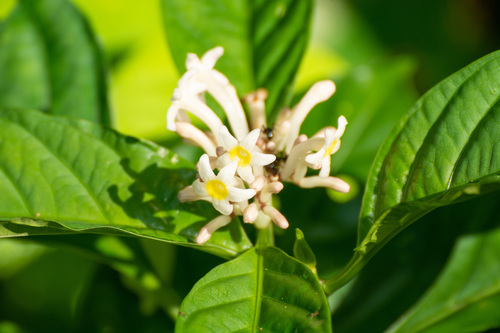
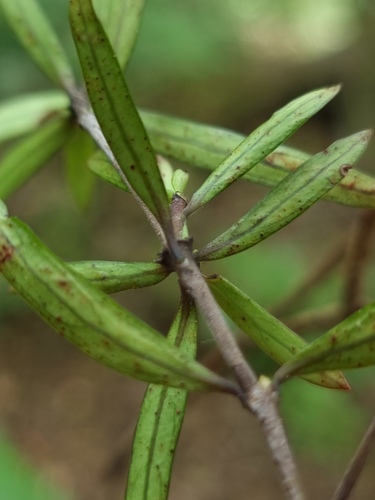
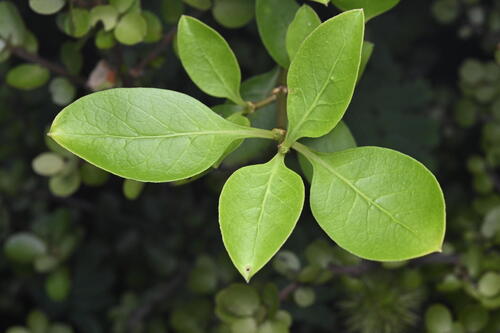
Coprosma foetidissima J.R.Forst. & G.Forst. grows as a small, openly branched tree or shrub. It typically reaches up to 3 m (9.8 ft) tall, but specimens on the Auckland Islands can grow as tall as 6 m (20 ft), with a trunk up to 45 cm (18 in) in diameter. Its bark is dark brown, and its branchlets are glabrous, meaning they do not have any hairs. Its interpetiolar stipules are shorter than those of many other Coprosma species, taper to a conspicuous tooth fringed by fine short hairs, and have uneven tufts of hairs at their tips. Its leaves are thin, 30-50 mm long, 14-20 mm wide, and somewhat leathery in texture, ranging in shape from obovate to oblong to broadly ovate. Leaf tips can be rounded, or end in a small tapered point. The leaves lie in a single plane along the branchlet. Like many other species in the Rubiaceae family, the leaves of C. foetidissima have domatia: small indentations on the leaf underside that may be occupied by potentially beneficial insects, such as mites and other arthropods. C. foetidissima is dioecious, which means male and female flowers grow on separate individual plants. Flowering takes place between October and November. The flowers are solitary and grow at the ends of branchlets. Male flowers have a cup-like calyx with four or five teeth; a bell-shaped corolla with 4 or 8 lobes extending to the middle of the corolla; and large anthers that are elongate-oblong in shape, and as long as the corolla. Female flowers have a short, narrowly ovoid, tubular calyx with teeth. Their corolla is a curved tube with 4 or 5 splits that extend one-third to halfway down the tube. The styles are long and substantial. Fruiting occurs between March and July. The drupes are 7–10 mm (0.28–0.39 in) long, oblong in shape, and range in colour from yellow to orange-red. They are dispersed primarily by birds. C. foetidissima is endemic to New Zealand. It is found from the Coromandel Peninsula southwards to Stewart Island, and also occurs on the Auckland Islands. It grows in coastal to sub-alpine forest and shrubland. A wide range of endemic New Zealand insects feed on C. foetidissima. These include three species of gall mites in the family Eriophyidae, five species of moth and butterfly caterpillars in the families Gracillariidae, Tortricidae and Geometridae, eight species of scale insects and sucking bugs in the families Aleyrodidae, Eriococcidae, Diaspididae and Miridae, and larvae of one species of gall fly in the family Cecidomyiidae. Seven species of weevil in the family Curculionidae live in dead wood of C. foetidissima. The Wellington tree wētā, Hemideina crassidens, has also been observed feeding on its leaves.