About Coprosma arborea Kirk
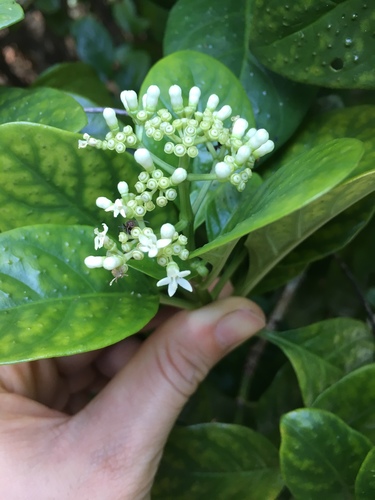
Coprosma arborea is a tree species native to New Zealand, and Māori people traditionally know it by the name mamangi. Its flowers have unnoticeable petals, are pollinated by wind, and bear long anthers and stigmas. The fruit of this species is a non-toxic juicy berry that contains two small seeds. One common location where this species grows is the Hamilton Ecological District, located on New Zealand's North Island. This tree grows to approximately 10 meters tall, with a trunk measuring 2 to 4 decimeters in diameter. It has closely spaced branches and slender, pubescent branchlets. Its leaves are borne on petioles that are winged in the upper half, and the petioles measure 8 to 20 millimeters long, most frequently 12 millimeters. The stipules are short and triangular, connate near the base, ciliolate, and have a prominent denticle. The leaf blade is rather thin, glabrous, and ranges in shape from ovate to broad-elliptic to oblong, occasionally being suborbicular. The leaf apex is rounded or retuse, and sometimes apiculate or mucronulate. The blade narrows cuneately or abruptly to the petiole. Leaf margins are thickened, indistinctly waved, and often subcrenulate. Mature leaf blades are roughly 50 to 60 millimeters long by 35 to 40 millimeters wide; leaves on young plants are smaller, with blades measuring roughly 15 to 25 millimeters long by 10 to 17 millimeters wide. Leaf reticulations are obscure on the upper leaf surface, and usually distinct on the lower surface. Male flowers form dense glomerules at the terminals of main and axillary branches; their calyx teeth are linear, obtuse, and ciliolate, their corolla is funnelform, and their corolla lobes are ovoid, acute, and roughly equal in length to the corolla tube. Female flowers grow in clusters of 2 to 4; their calyx teeth are obtuse and ciliolate, their corolla tube is short, and their corolla lobes are long and acute. The drupe is white and broad-oblong, measuring approximately 7 millimeters long.