About Coprinus comatus (O.F.Müll.) Pers.
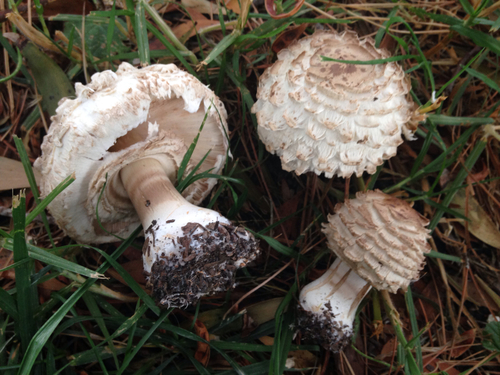
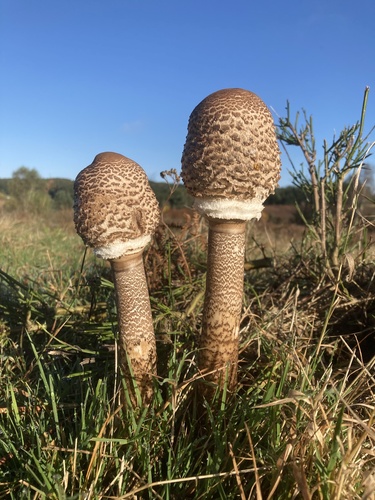
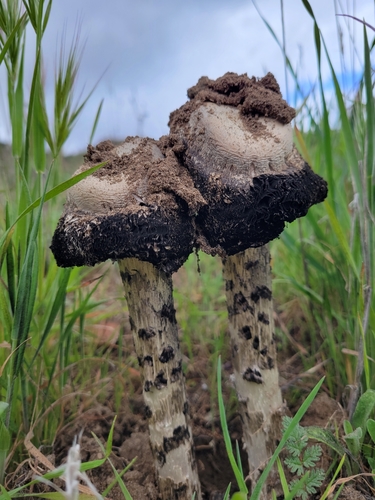
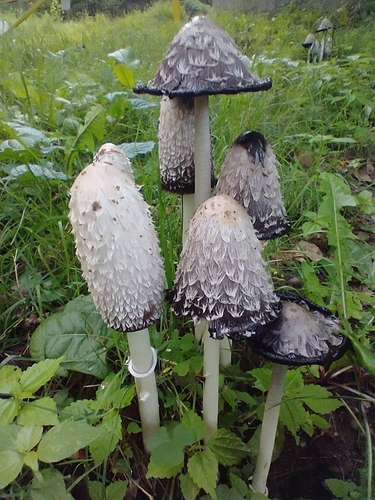
Coprinus comatus, commonly known as the shaggy ink cap, is easily recognizable by its nearly cylindrical cap that initially covers most of its stem. The cap measures 4 to 8 centimeters (1+1⁄2 to 3+1⁄4 inches) wide and 6 to 20 centimeters (2+1⁄2 to 8 inches) tall. It is mostly white, covered in shaggy scales that are pale brown towards the cap apex. The free gills change color quickly, starting white before turning pink, and then deliquesce (melt) into a black liquid filled with spores — this trait gives the species its common name "ink cap". The entire mushroom is deliquescent. The stipe (stem) is white, fairly thick, and measures 6 to 40 centimeters (2 to 16 inches) high by 1 to 2.5 centimeters (1⁄2 to 1 inch) in diameter, with a loose ring located near its bottom. When examined microscopically, this mushroom does not have pleurocystidia. Its spore print is black-brown, and individual spores measure 10–13 by 6.5–8 micrometers. The flesh is white with a mild taste. This species grows in groups in grasslands and meadows. It is found in North America and Europe, and fruits from June to November in the United Kingdom. It is thought to have been introduced to Australia, New Zealand, and Iceland. Ecologically, Coprinus comatus is a nematophagous fungus, meaning it can kill and digest the nematode species Panagrellus redivivus and Meloidogyne arenaria.