About Coprinopsis picacea (Bull.) Redhead, Vilgalys & Moncalvo
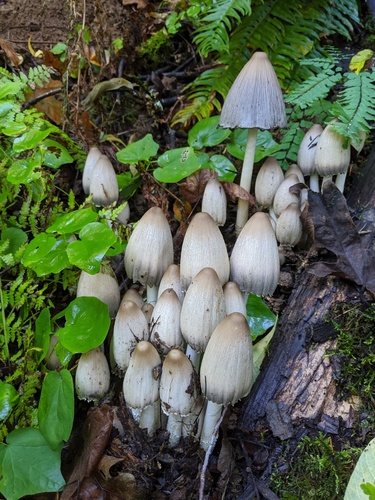
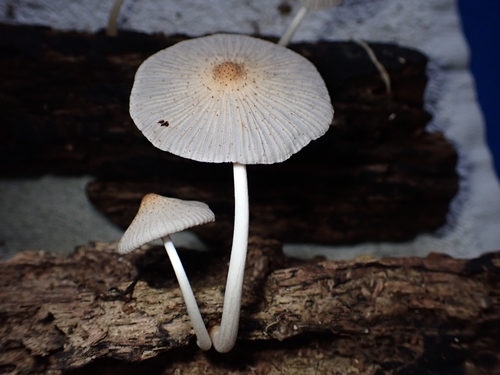
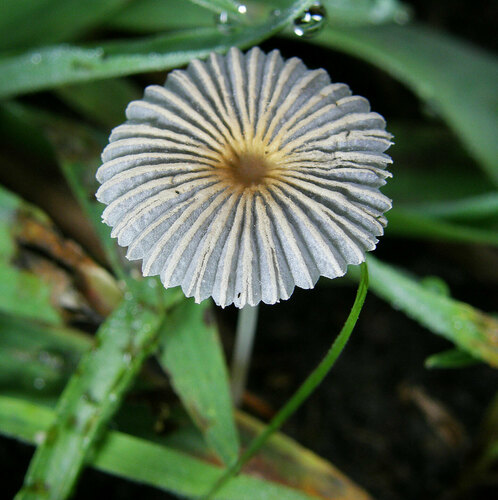
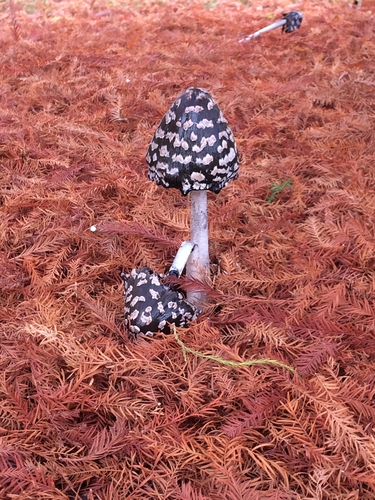
Coprinopsis picacea, commonly called the magpie inkcap, has the following characteristics. The cap starts egg-shaped, then expands into a bell shape that reaches up to 8 centimetres (3 in) wide. Very young specimens have serrated, white caps. As the mushroom ages, the cap breaks open to reveal a dark brown background that eventually turns black. White, grayish to cream-colored remnants of the velum stay on the cap as flakes, creating a pattern that resembles woodpecker or magpie plumage. As it matures, the edge of the cap rolls upward and dissolves. The lamellae are mostly free and very densely packed. They start white, then turn reddish, and eventually melt into a dripping black substance — this feature gives the group the common name inkcap. The whitish stalk is 12–20 (up to 30) cm long and 6–15 mm thick. It is hollow, not very sturdy, slightly narrower toward the top, and covered with scales or fine fibers. The flesh is whitish, with a fibrous, watery texture. It sometimes has an unpleasant smell similar to moth powder, and also has an unpleasant taste. This species is common across Europe and Australia, and also occurs in North America, where it is uncommon. In Europe, its range extends from Great Britain and France in the west, east to Poland, Hungary and Romania, south to Spain, the Balearic Islands, Italy and Greece, and north to Germany and Denmark. This species is inedible, causes digestive upset, and is considered poisonous for some people.