About Coprinopsis atramentaria (Bull.) Redhead, Vilgalys & Moncalvo
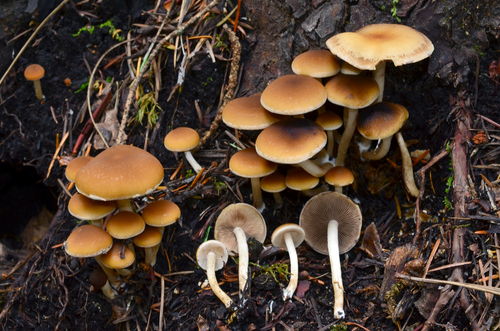
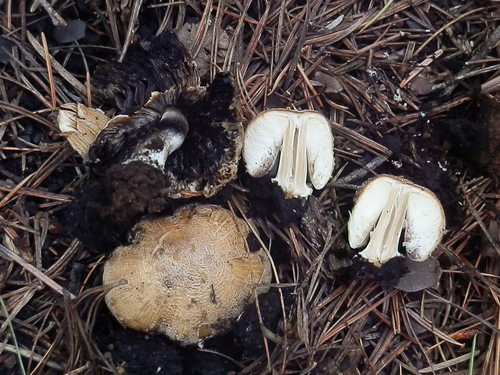
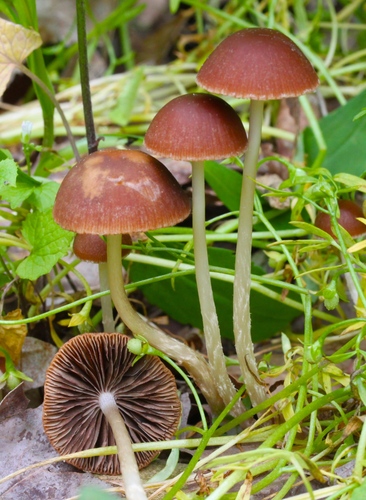
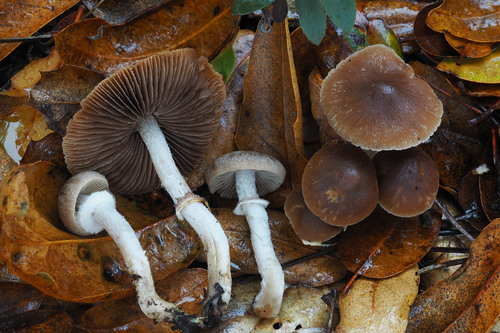
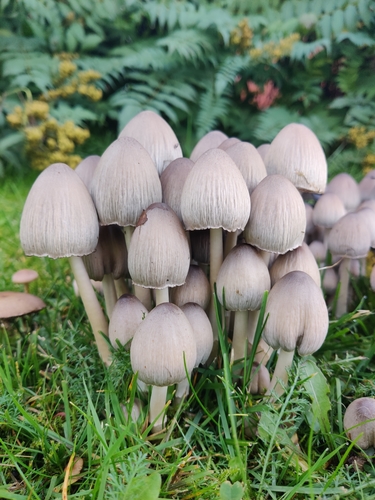
This species, Coprinopsis atramentaria, has a cap that ranges from 3 to 10 centimetres (1+1⁄4–4 inches) in diameter. The cap is greyish or brownish-grey, furrowed, starts out bell-shaped and becomes more convex as it matures, and splits along its margin. It digests itself starting from the outer edge inward. Its gills are very crowded and free from attachment to the stipe; they begin white, turn grey or pinkish, then become black and break down into liquid. The stipe is 5–17 cm (2–6+3⁄4 in) tall and 1–2 cm thick, it is grey and has no ring. In young clustered growths, the stems may be hidden by the caps. The spore print is black, and the almond-shaped spores are 8–11 by 5–6 micrometres in size. The flesh is thin and pale grey. This fungus occurs across the entire Northern Hemisphere, including Eurasia and North America, and has also been recorded in South Africa and Australia. In Australia, it has been found in urban sites such as the Royal Botanic Gardens in Sydney and areas around Lake Torrens. Like many other ink cap species, it grows in clustered tufts. It is commonly associated with buried wood, and can be found in grasslands, meadows, disturbed ground, and open terrain from late spring to autumn. Its fruiting bodies have been observed pushing through asphalt and even tennis courts. It is also common in urban areas, growing in vacant lots, and its tufts can become quite large and produce fruiting bodies multiple times per year. If you dig up the growth, you will often find the mycelium growing from buried dead wood. Young Coprinopsis atramentaria mushrooms are considered edible, but consuming them within a few hours of alcohol causes disulfiram-like symptoms. This harmful interaction has only been recognized since the early 20th century. Symptoms include facial reddening, nausea, vomiting, malaise, agitation, palpitations, and tingling in the limbs, and they develop five to ten minutes after alcohol is consumed. If no more alcohol is ingested, the symptoms generally fade within two to three hours. Symptom severity corresponds to how much alcohol was consumed; symptoms become noticeable when blood alcohol concentration reaches 5 mg/dl, and are prominent at 50–100 mg/dl. Disulfiram itself is known to cause myocardial infarction (heart attack). Symptoms can appear even after drinking a small amount of alcohol up to three days after eating the mushrooms, though symptoms become milder as more time passes. Rarely, cardiac arrhythmia such as atrial fibrillation occurring with supraventricular tachycardia may develop. Because of this alcohol-interacting effect, the mushroom has sometimes been used to treat alcoholism. The fungus contains a cyclopropylglutamine compound called coprine. Its active metabolite, 1-aminocyclopropanol, blocks the activity of acetaldehyde dehydrogenase, the enzyme that breaks down acetaldehyde in the human body. Acetaldehyde is an intermediate metabolite formed when the body processes ethanol, and it causes most hangover symptoms; its effect on autonomic β receptors is responsible for the vasomotor symptoms. Treatment for the reaction involves reassuring the patient that the often frightening symptoms will resolve, replacing fluids lost from vomiting, and monitoring for cardiac arrhythmias. Laboratory testing found that large, prolonged doses of coprine caused gonadotoxic effects in rats and dogs.