About Copera vittata (Selys, 1863)
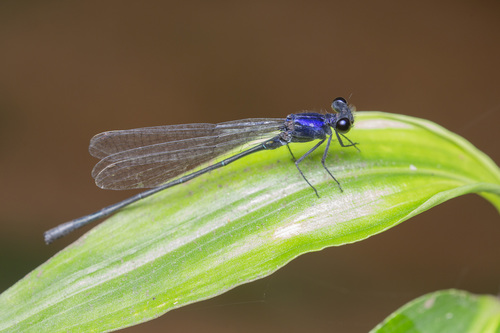
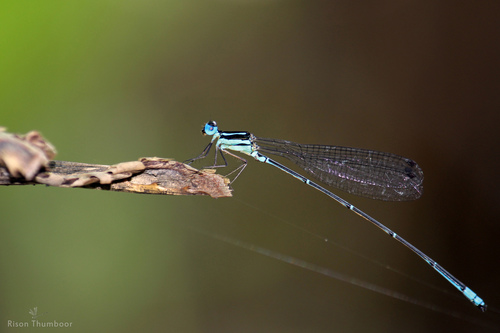
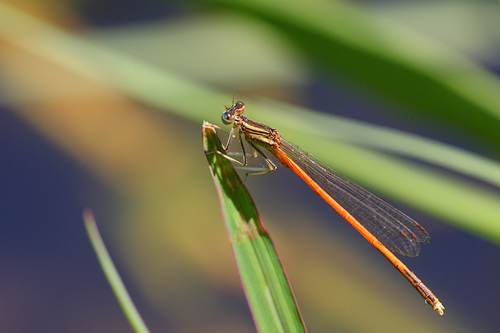
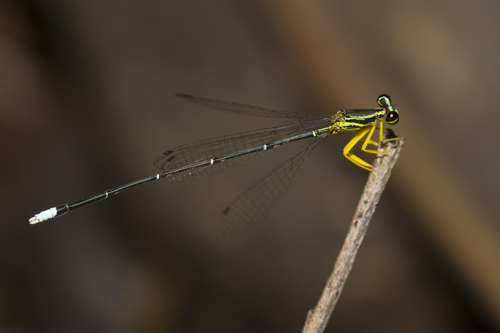
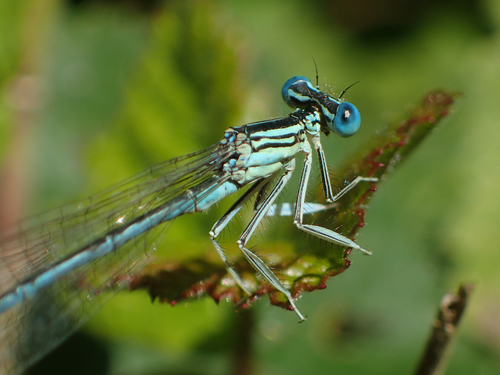
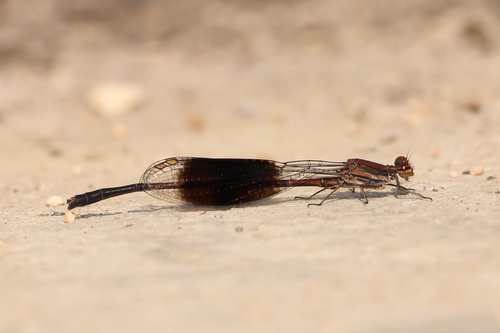
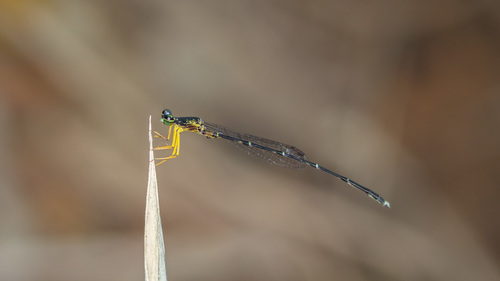
Copera vittata is a medium-sized damselfly. It has brown-capped yellow eyes, with a narrow equatorial black band circling each eye. Its dorsum thorax is black, marked with a narrow bluish-yellow humeral stripe that is split into two overlapping pieces. This stripe is followed by a broad black fascia on the middle of the thorax’s lateral side, which is dotted with small pale yellow spots. Lateral sides of the thorax beyond this fascia are yellow, with an irregular black stripe on the anterior border of the postero-lateral suture, and a second irregular black stripe on the middle portion of the metepimeron. The dorsal half of the abdomen is black up to segment 8, while the ventral half is paler, with bluish-white basal annules. Segment 9 is black on its basal half and bluish-white on its apical half. Segment 10 is bluish-white. Anal appendages are pale blue or creamy white. The superior anal appendages are the same length as segment 10, conical, and taper at their apices. The inferior anal appendages are nearly twice as long as the superior appendages; they are pale on the inside and blackish-brown on the outside. This differs from the related species Copera marginipes, where superior appendages are half the length of segment 10, inferior appendages are at least four times the length of the superiors, and the inferior appendages have black tips on their underside. Females of Copera vittata are more robust than males, have duller colors, and less clearly defined markings. Teneral individuals of both sexes can be entirely white with only a few black markings. This species is commonly found among undergrowth along river and stream banks, and it often occurs in hilly areas.