About Contopus punensis Lawrence, 1869
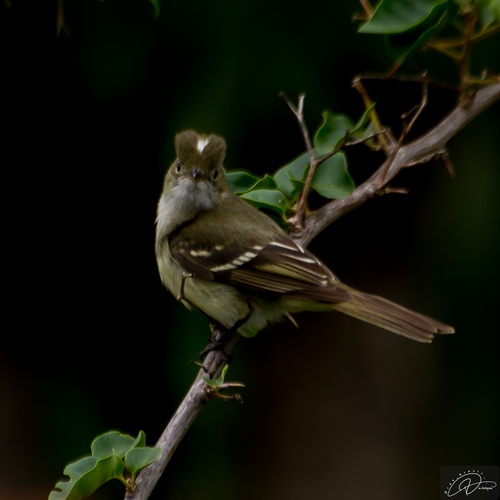
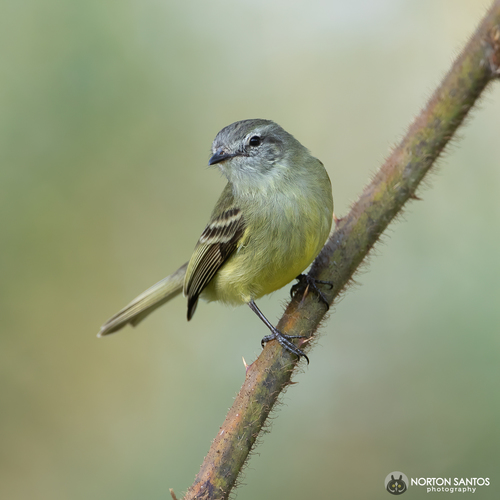
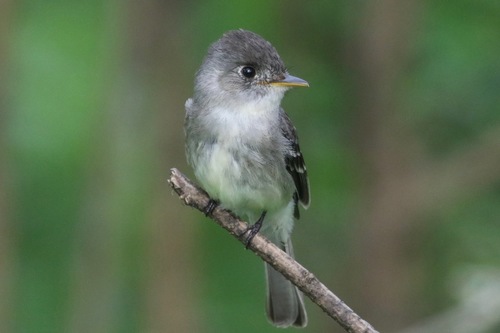
The Tumbes pewee (Contopus punensis Lawrence, 1869) measures 13 to 14 cm (5.1 to 5.5 in) in length; three measured females have an average weight of 9.3 g (0.33 oz). Both sexes share identical plumage. Adult individuals have a dark olive-gray crown with a slight crest, white to grayish white lores, and a thin white eye-ring, set against an otherwise pale grayish olive face. Their back is olive-gray, while their rump and uppertail coverts are brownish olive-gray, with a hidden white feather tuft on each side of the rump. Their wings are mostly dusky: the wing secondaries have white to brownish gray edges at their ends, and the median and greater coverts have grayish white to brownish gray tips that form two thin wing bars. Their tail is olive-gray. Their chin and throat are white, their breast and upper belly are pale grayish olive, their lower belly is whitish, and their undertail coverts are pale brown. The species' bare parts have not been formally described, but they are believed to match those of the closely related northern tropical pewee (C. bogotensis), which has a dark brown iris, a black maxilla, a yellowish or orangey mandible, and blackish legs and feet. The Tumbes pewee is distributed from northern Manabí Province in northwestern Ecuador south into northwestern and west-central Peru, reaching the Department of Huancavelica. There are also recorded observations of the species in far northeastern Ecuador's Esmeraldas Province, and it is suspected to occur in southwestern Colombia as well. It inhabits semi-open landscapes, including deciduous and semi-humid woodlands, Podocarpus woodlands, edges and clearings of denser forest, and occurs locally in mangroves. In terms of elevation, it is found mostly below 1,500 m (4,900 ft) in Ecuador, though it can reach as high as 1,900 m (6,200 ft) there, and occurs up to 2,800 m (9,200 ft) in Peru.