About Contopus pertinax Cabanis & Heine, 1859
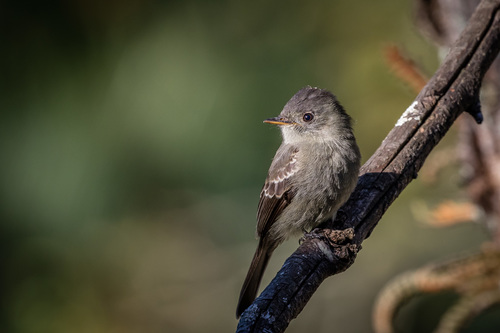
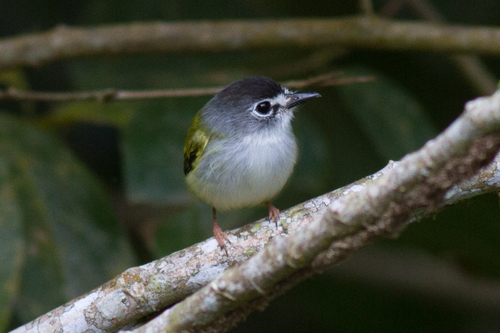
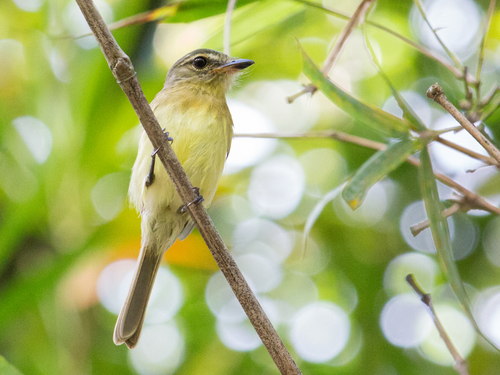
Contopus pertinax, commonly called the greater pewee, measures 18 to 20 cm (7.1 to 7.9 in) in length and weighs approximately 22 to 36 g (0.78 to 1.3 oz). Males and females have identical plumage, and both feature a spiky crest. The subspecies C. p. minor is smaller than the nominate subspecies, but their plumage is essentially the same. Adult greater pewees have a plain olive-gray head and upperparts, with pale lores and a face that is slightly lighter than the rest of the head. Their wings are dusky grayish brown, with grayish olive tips on the coverts that form two faint wing bars. The secondaries have pale grayish edges. Their tail is dusky grayish brown. The chin is dull whitish, while the throat and sides are olive-gray with a buffy yellowish tinge. The center of the breast, belly, and undertail coverts are buffy. Plumage fades with wear, becoming less olive. Both subspecies have a brown iris, a dusky brown to almost black upper mandible (maxilla), a yellowish to orange lower mandible, and dusky brown to blackish legs and feet. The greater pewee has a disjunct distribution, with river valleys and lowlands separating some of its populations. The nominate subspecies is the more northerly of the two, ranging from central and southeastern Arizona and southwestern New Mexico in the United States, south through western and southern Mexico to the Isthmus of Tehuantepec; during migration it travels further south into Guatemala. Subspecies C. p. minor occurs from east of the Isthmus of Tehuantepec, ranging intermittently through Guatemala, Belize, El Salvador, and Honduras to far north-central Nicaragua. The nominate subspecies has been recorded as a vagrant in California, and small numbers migrate through western Texas. The greater pewee primarily inhabits pine and pine-oak forest in the subtropical and temperate zones. During migration and to some extent during the non-breeding season, it also occurs in deciduous riparian forest located within pine and pine-oak forest, and does not occur in more open areas. Across its entire range, it is found at elevations between 900 and 3,400 m (3,000 and 11,200 ft). In the northern part of its range, it mostly occurs between 2,100 and 3,000 m (6,900 and 9,800 ft); in Oaxaca it occurs between 1,360 and 2,575 m (4,500 and 8,400 ft). South of Mexico, it mostly occurs between 1,300 and 3,350 m (4,300 and 11,000 ft), but has been recorded as low as 400 m (1,300 ft).