About Contopus latirostris (J.Verreaux, 1866)
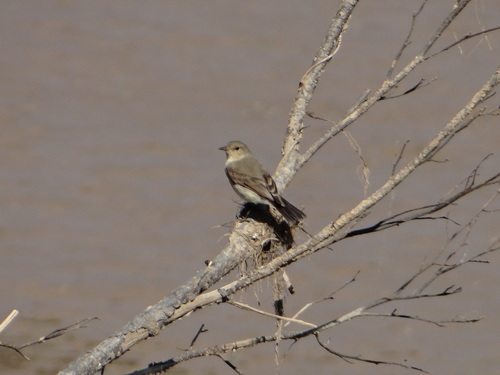
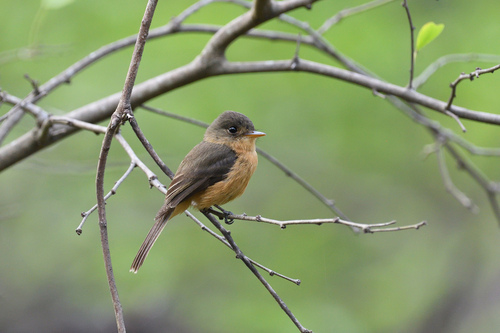
Contopus latirostris, commonly called the Lesser Antillean pewee, has three recognized subspecies. All three grow to an adult length of approximately 15 cm (5.9 in), and males and females of each subspecies have identical appearance. The nominate subspecies has dark sooty brown crowns, olive-brown faces with a faint fulvous tinge, and olive-brown upperparts that carry a cinnamon tinge on the rump and uppertail coverts. Their tail is dark grayish brown, with pale grayish brown or buffy feather tips and light grayish brown feather edges. Their wings are mostly dusky, with pale cinnamon buff or grayish buff edges along the secondaries. Their underparts are colored cinnamon tawny or dull tawny ochraceous. Members of this subspecies have brown irises, a horn brown maxilla, a whitish mandible, and dusky brown legs and feet. Adults of the subspecies C. l. blancoi have dark sooty olive to sooty blackish crowns, deep olive heads and upperparts, and a dusky grayish brown tail with faint olive coloring on the feather edges. Their wings are mostly dusky, with thin paler edges near the tips of the coverts and pale brownish buff edges on the secondaries. Their underparts are mostly deep brownish buff, with paler undertail coverts and a dark olive tint on the breast and sides. They have brown irises, a brownish black or blackish brown maxilla, a pale mandible that usually has a dusky tip, and dusky brown or blackish legs and feet. Adults of the subspecies C. l. brunneicapillus have dark sooty brown to sooty black crowns, and dark brownish olive to olive-brown faces and upperparts, with paler, browner rump and uppertail coverts. Their tail is deep grayish brown, with pale grayish brown or olive coloring on the outer feather webs. Their wings are mostly dusky, with grayish brown or olive tips on the coverts and pale brownish buffy edges on the secondaries. Their chin and throat are buffy white or buffy grayish white, and their underparts are mostly brownish buffy with a strong grayish olive cast on the breast and sides. They have brown irises, a dusky brown maxilla, a pale mandible that usually has a dusky tip, and dusky brown or brownish black legs and feet. In terms of distribution and habitat, the nominate subspecies occurs on St. Lucia, where it primarily lives in montane forest. Subspecies C. l. blancoi occurs on Puerto Rico, where it is rare in the eastern third of the island, and it also primarily inhabits montane forest. Both the nominate subspecies and C. l. blancoi are also found in lower elevation forest, wooded hills, coffee plantations, and locally in semi-arid scrublands and coastal mangroves. C. l. brunneicapillus occurs on Guadeloupe, Dominica, and Martinique. On these islands, it lives in the same range of habitat types as the other two subspecies, but does not show a preference for any single habitat. The entire species occurs in the tropical zone, ranging from sea level up to approximately 900 m (3,000 ft) in elevation. Individual Lesser Antillean pewees have occasionally been recorded in the mountains of St. Kitts, but it is unknown whether these are vagrant individuals or remnants of a previously larger, stable population on the island.