About Contopus hispaniolensis (H.Bryant, 1867)
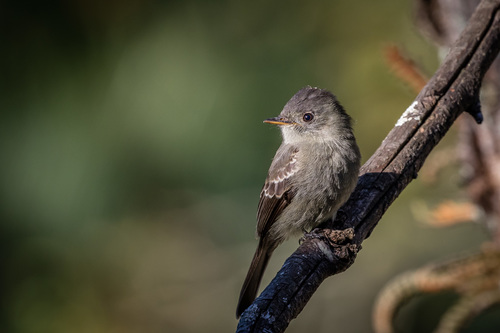
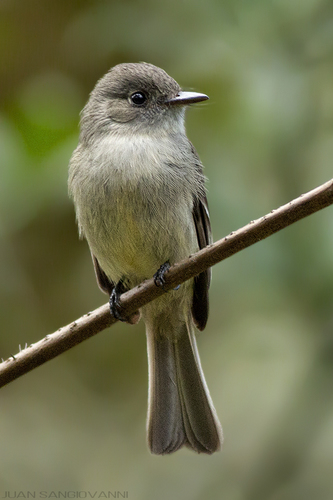
The Hispaniolan pewee, scientific name Contopus hispaniolensis (H.Bryant, 1867), is 15 to 16 cm (5.9 to 6.3 in) long and weighs about 11.5 g (0.41 oz). Males and females have identical plumage, and the species' two subspecies are also similar to one another. Adult Hispaniolan pewees have a grayish olive head and back, with a slightly darker crown. Their wings are dusky, and sometimes show two faint wing bars. Their tail is dusky. Their throat is gray, their breast is gray with an olive wash across it, and their belly and undertail coverts are yellowish buff mixed with some gray. Juveniles have pale fringes on the feathers of their crown, back, and wing coverts. Adults have a dark iris, a wide blackish bill with a paler base to the lower mandible, and blackish legs and feet. The nominate subspecies is found across the main island of Hispaniola. Subspecies C. h. tacitus occurs on Gonâve Island off the western coast of Haiti. The species has been documented as a vagrant on Mona Island, which lies to the east between Hispaniola and Puerto Rico. It has also been recorded on Providenciales Island in the Turks and Caicos Islands after a hurricane. The species lives in a range of wooded habitats in tropical and subtropical zones, including evergreen and deciduous broadleaf forest, pine forest, shade coffee plantations, and orchards. It occurs at elevations from sea level up to 2,000 m (6,600 ft).