About Contopus cinereus bogotensis (Bonaparte, 1850)
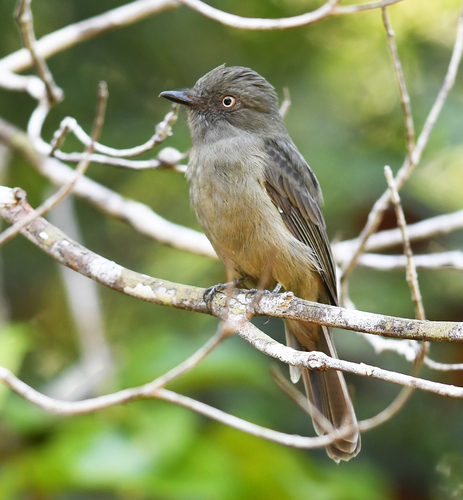
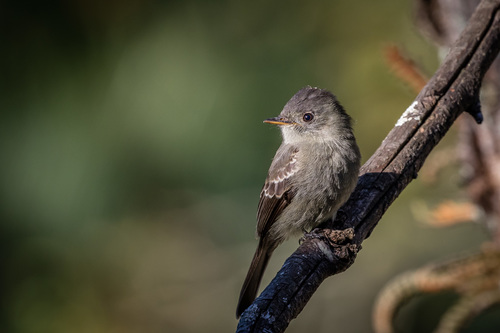
The southern tropical pewee measures 13.5 to 14.5 cm (5.3 to 5.7 in) in length and weighs approximately 10 to 15 g (0.35 to 0.53 oz). Both sexes share identical plumage. Adults of the nominate subspecies have a dark blackish gray crown with a small crest, white to grayish white lores, and a thin white eye-ring on an otherwise grayish olive face. Their back is sooty olive-gray, while their rump and uppertail coverts are brownish olive, with a hidden white feather tuft on each side of the rump. Their wings are mostly dusky: secondaries have white to brownish gray edges at their tips, and the median and greater coverts have grayish white to brownish gray tips that form two thin wing bars. Their tail is olive-gray. Their chin and throat are white, their upper breast is white with a gray tinge, their lower breast and belly are white to yellowish white, and their undertail coverts are pale brown. Juveniles have browner upperparts than adults, with buff to cinnamon-buff edges on their feathers. Their wing coverts have wide pale cinnamon-buff tips, and their chin is brown. Subspecies C. c. pallescens has a darker crown than the nominate subspecies, but is otherwise identical. Both subspecies have a dark brown iris, a sepia brown maxilla, a paler more orangey mandible, and sepia-brown legs and feet.
Two subspecies of the southern tropical pewee are recognized, with C. c. pallescens ranging further north than the nominate subspecies. C. c. pallescens occurs in central and eastern Brazil, roughly bounded by southern Maranhão, Pernambuco, and Mato Grosso do Sul, and extends south through eastern Bolivia and northern Paraguay into northwestern Argentina as far as Tucumán Province. The nominate subspecies is found in southeastern Brazil from Bahia to Santa Catarina, and ranges south through central and southeastern Paraguay into Misiones Province, northeastern Argentina. The species, believed to be C. c. pallescens, also occurs as a rare migrant in southeastern Peru.
The southern tropical pewee lives in a range of semi-open landscapes, including light woodlands, secondary woodlands, plantations, and the edges of semi-deciduous forest. It mostly occurs at elevations below 1,300 m (4,300 ft), but reaches up to 1,800 m (5,900 ft) in Brazil, 2,000 m (6,600 ft) in Argentina, and exceptionally up to 2,850 m (9,400 ft) in Bolivia.