About Contopus caribaeus (Orbigny, 1839)
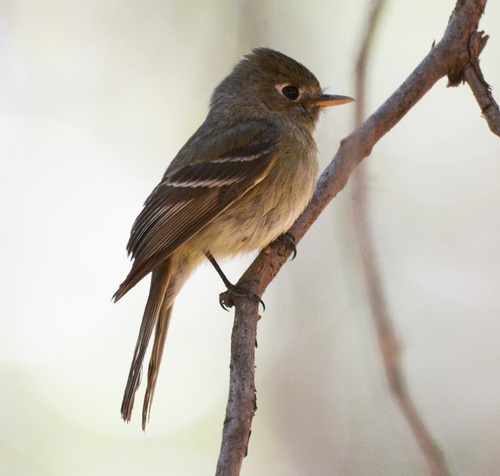
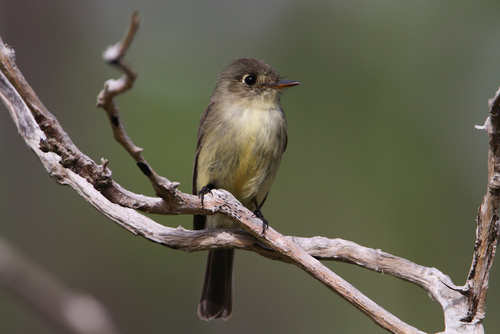
The Cuban pewee (Contopus caribaeus) measures 15 to 16.5 cm (5.9 to 6.5 in) in length and weighs 8.5 to 13.5 g (0.30 to 0.48 oz). Males and females have identical plumage. Adult individuals of the nominate subspecies C. c. caribaeus have a dark olive-gray crown with a slight crest, slightly paler olive-gray lores, and a whitish crescent around the back of the eye set against an otherwise olive-brown face. Their back is also olive-brown. Their wings are dusky brown, with pale tips on the coverts that form two faint wing bars. The outer secondaries and tertials of the wing have whitish edges. Their tail is dusky. Their throat is pale gray with a faint buff tinge, their breast is beige-gray with an olive wash on the sides, and their belly and undertail coverts are buffy mustard-yellow. Juveniles have wider, buffy white wing bars. Subspecies C. c. bahamensis is duller, grayer, and paler than the nominate subspecies, with only a slight yellow tinge on the belly. Subspecies C. c. morenoi and C. c. nerlyi are generally intermediate between the nominate and bahamensis subspecies, but have mostly buffish underparts. All subspecies have a dark iris, a wide flat bill with a black maxilla and orange-yellow mandible, and black legs and feet. The subspecies of the Cuban pewee have the following distinct distributions: C. c. bahamensis occurs on Grand Bahama, Great Abaco, New Providence, Eleuthera, Cat, and Andros islands in the northern Bahamas; C. c. caribaeus occurs on mainland Cuba and Isla de la Juventud (Isle of Pines); C. c. morenoi occurs on the south coast of mainland Cuba, especially in Zapata Swamp, and on nearby cays; C. c. nerlyi occurs in Jardines de la Reina and on nearby islands off the southern coast of mainland Cuba. The Cuban pewee lives in the interior and edges of broadleaf and pine forest, brushy scrublands, swampy areas, and tree plantations in tropical and upper tropical zones. Subspecies C. c. morenoi is found primarily in mangroves. In terms of elevation, the species ranges from sea level to 1,800 m (5,900 ft), though it is rarer above 1,000 m (3,300 ft).