About Consolea corallicola Small
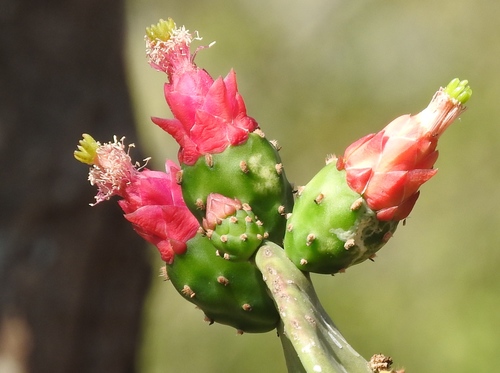
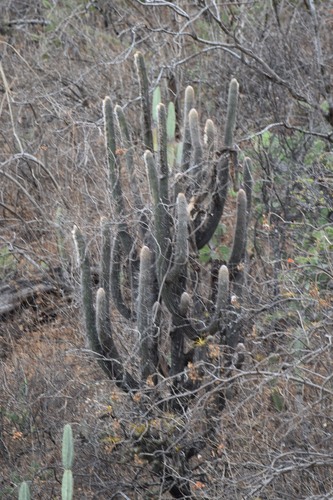
Consolea corallicola Small is a tree-like cactus that grows up to 2.4 meters (8 feet) tall. Its stem segments can reach 40 centimeters in length, and are copiously armed with pink spines that may grow longer than 12 centimeters. Spines on the trunk all point downward, and are the largest spines found on the plant. The flowers of this cactus have a scent similar to rotting meat, with fleshy outer tepals and red inner tepals that measure up to 2.5 centimeters long. Flowering happens year-round, with a peak season from December to April. This cactus grows in colonial clumps, forming colonies of trunked plants alongside several pups. Its common name refers to its resemblance to railway semaphore signals. This species has been completely removed from several of the Florida Keys, including Big Pine Key, the island where it was first discovered in 1919. Today, only two native populations exist: one on Little Torch Key and one on Swan Key. A group of plants also grows on North Key Largo, where several fragments of the cactus were planted. Because the species is colonial, many apparent separate plants are actually genetically identical parts of a single individual, so true population sizes are very small, sometimes with fewer than five distinct genetic individuals. One population consists only of male plants, and cannot reproduce sexually. In total, there are fewer than 20 distinct wild individuals alive today. It is listed as critically endangered by the IUCN. This cactus grows on bare rock with thin pockets of humus, located in hardwood hammocks or the ecotone between hammock and mangrove habitat. Its substrate is Key Largo limestone covered with sand, and its habitat sits near sea level. Plant species associated with Consolea corallicola include Sporobolus virginicus, Conocarpus erectus, Maytenus phyllanthoides, Manilkara bahamensis, Hippomane mancinella, and Opuntia stricta var. dillenii.