About Conradina verticillata Jennison
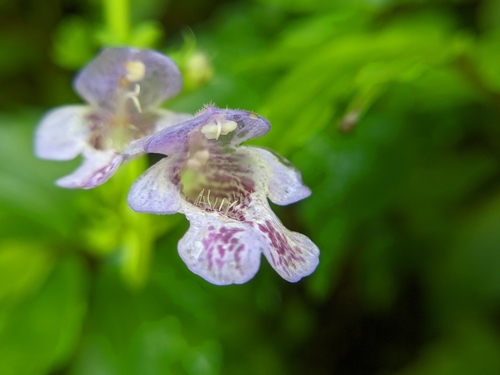
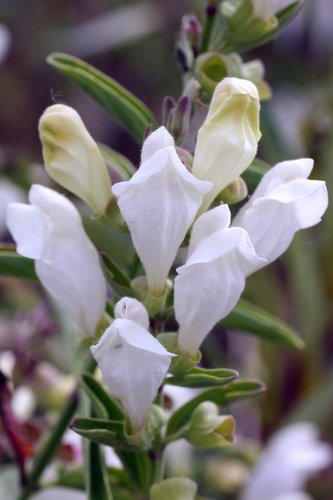
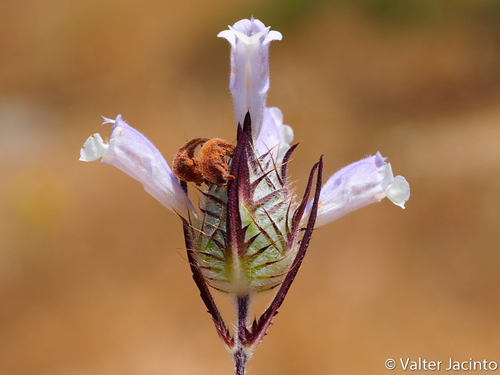
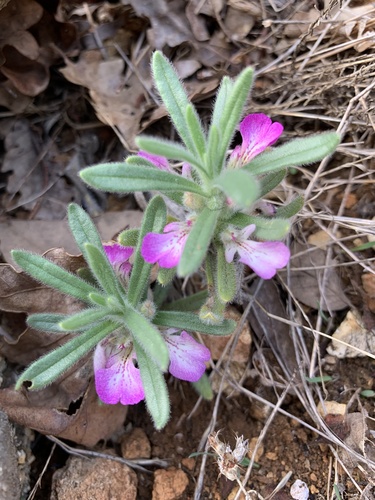
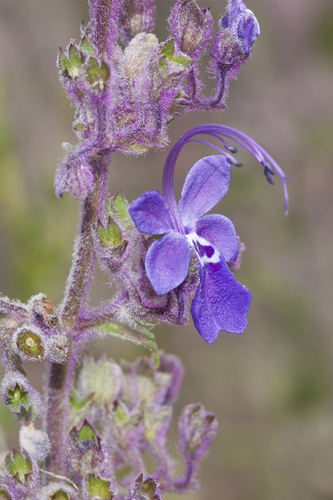
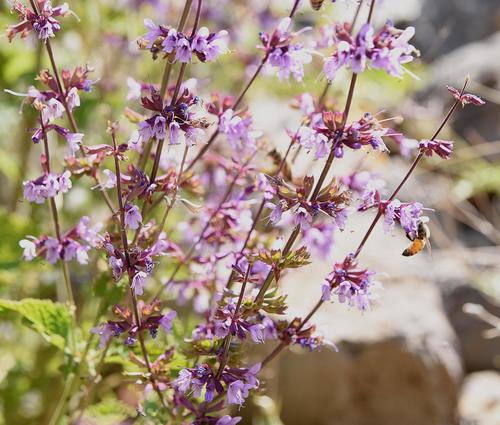
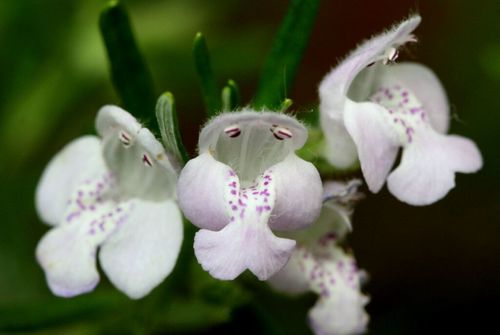
Conradina verticillata Jennison, commonly called Cumberland rosemary, is a shrub that grows to around 50 cm tall. It bears needle-like aromatic leaves that smell similar to rosemary. Its flowers are most often lavender or purple, and more rarely white; each flower is 1 to 2 cm long, with darker spots at its center. In profile, the flowers may take on an S-shape from curving of the floral cup. This species has a bilabiate calyx 7 to 9 mm long with a glandular-hairy surface. It can be difficult to distinguish individual Cumberland rosemary plants by eye: what appear to be separate plants are often parts of a single sprawling plant. This growth pattern develops because stems fall over once they grow taller than 30 cm, and these horizontal branches root at their nodes to produce new vertical stems. Since the plant grows in gravelly environments that experience periodic flooding, sand and rocks often cover the horizontal connecting stems, hiding their connection. When not in flower, Cumberland rosemary can resemble other needle-leaved species: Aster linariifolius, Hypericum densiflorum, and Pycnanthemum tenuifolium. None of these similar species produce a rosemary aroma, however. Cumberland rosemary grows on rocky river banks of the Cumberland Plateau. It grows best in full sunlight and well-drained soil with no visible organic matter; this soil is typically mostly sand, or a mixture of sand and gravel. It benefits from topographic features that increase sand deposition, and relies on periodic flooding to remove taller plants that would shade it out. Extended flooding can encourage rooting at lower stem nodes, and disperse both seeds and viable plant fragments downstream. It has been hypothesized that Cumberland rosemary may thrive under a regime of alternating floods and extreme droughts, which eliminates competing plants, but there is currently no data to confirm this idea. When Cumberland rosemary was federally listed, the U.S. Fish and Wildlife Service chose not to designate a critical habitat for the species. The plant’s known locations are isolated, so visitors are unlikely to encounter them by chance; the agency worried that designating a critical habitat would attract collectors, or curious local people who could accidentally damage the populations. The U.S. Fish and Wildlife Service stated it would instead contact private landowners who have Cumberland rosemary colonies growing on their property. Cumberland rosemary is only found on the Cumberland Plateau in the U.S. states of Tennessee and Kentucky. At the time of its federal listing in 1991, Tennessee hosted three populations along the South Fork Cumberland River, Caney Fork River, and Obed River system, for a total of 44 known colonies. The single Kentucky population is also along the South Fork Cumberland River, and held four known colonies at that time. A 1996 report counted 79 colonies in Tennessee and 12 in Kentucky. In 2010, observers counted a total of 60 colonies across both states, and 66 colonies were counted in 2017. Cumberland rosemary flowers from mid-May to early June. Each flower first produces pollen for up to one day, before its female reproductive parts become receptive. It is primarily pollinated by bumblebees and honeybees. Unpollinated flowers persist for one week, while pollinated flowers fall off the plant in just two days. Seeds mature in mid-June; the seeds are dark brown and 1 mm in diameter. Multiple studies have recorded low seed viability: Roulston (1994) found less than 10% of seeds germinate, while a later 2012 study by Albrecht and Penago recorded a higher germination rate of 26%. Low seed viability is thought to relate to the species’ clonal growth habit, since pollinators usually carry pollen between nearby flowers that belong to the same genetic individual. However, even with outcrossing, seed viability remains low. Germination takes two weeks, and is more likely to occur in warmer temperatures. Cumberland rosemary is the only triploid species in the Conradina genus.