About Conopias cinchoneti (Tschudi, 1844)
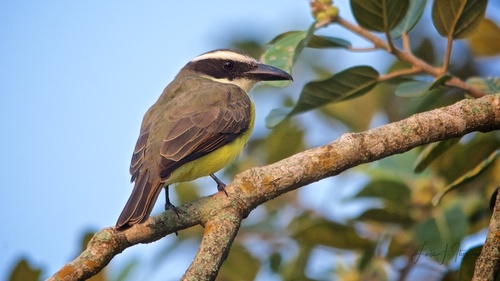
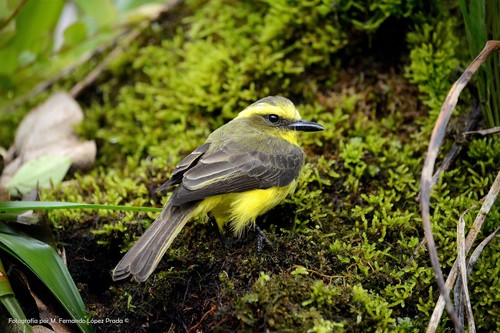
The lemon-browed flycatcher, with the scientific name Conopias cinchoneti (Tschudi, 1844), measures 15.5 to 16 cm (6.1 to 6.3 in) long. Males and females share identical plumage. Adults of the nominate subspecies have an olive-green crown and face, paired with a bright grayish yellow forehead and a wide pale yellow supercilium that wraps almost all the way around the nape. Their upperparts are dark olive, their wings are dusky brownish with paler edges on the tertials, and their tail is also dusky brownish. Their chin, throat, and underparts are bright yellow, with an olive tinge on the sides of the breast. Subspecies C. c. icterophrys is very similar to the nominate, differing only in possibly having less yellow on the forehead, a thinner supercilium, and a paler throat. Both subspecies have a dark iris, a moderately long black bill, and blackish legs and feet.
The lemon-browed flycatcher has a highly disjunct distribution. The differences between the two subspecies are slight and poorly defined, so their geographical distribution limits may require revision. Subspecies C. c. icterophrys is the more northerly of the two; as currently understood, it occurs in the Serranía del Perijá on the Colombia-Venezuela border, in the western Venezuelan Andes in Mérida and Trujillo states, in scattered locations across all three ranges of the Colombian Andes, and in extreme northern Ecuador's Carchi Province. The nominate subspecies occurs along the eastern slope of the Andes for nearly the entire length of Ecuador, and continues through northern and central Peru to the northern departments of Ayacucho and Cuzco. Unconfirmed sight records from Bolivia have led the South American Classification Committee of the American Ornithological Society to classify the species as hypothetical in Bolivia.
The lemon-browed flycatcher lives in a variety of semi-open landscapes, including small forest clearings, larger forest openings that retain some tall trees, and cloudforest edges. Its elevation range is 950 to 2,150 m (3,100 to 7,100 ft) in Venezuela, with unconfirmed sightings as low as 450 m (1,500 ft); 900 to 2,000 m (3,000 to 6,600 ft) in Colombia; mostly 1,000 to 2,000 m (3,300 to 6,600 ft) in Ecuador; and 800 to 1,950 m (2,600 to 6,400 ft) in Peru.