About Conophytum calculus (Berger) N.E.Br.
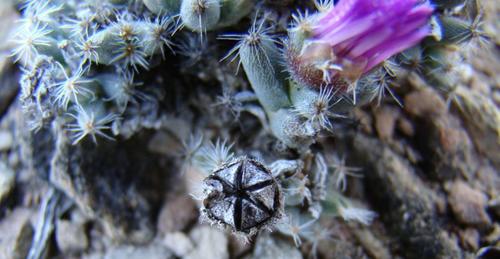
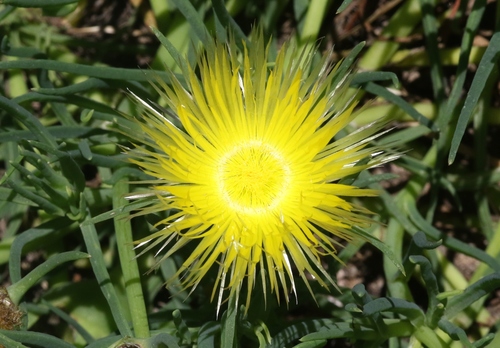
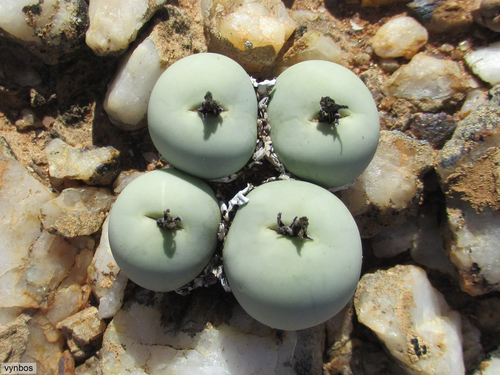
Conophytum calculus (Berger) N.E.Br. is a rounded, ball-shaped succulent that divides to form dense clumps. Its name comes from the Latin word 'calculus', meaning pebble, referring to its resemblance to pebbles and the firm texture of its flesh. This species produces yellow or orange flowers in autumn; the flowers open at night and carry a clove scent. The plant's characteristic ball shape forms when a pair of leaves fuses completely, leaving only a tiny slit at the top through which new flowers and subsequent leaf pairs emerge. A new leaf pair develops inside the existing ball formed by the old leaf pair. When the new leaf pair is ready, the old leaf pair's ball shrivels and dries out before the new ball splits it open. Both the living epidermis and the dried leaf sheath that remains are thick and strong. This species is extremely long-lived; individual plants have been kept in cultivation for over 50 years, and they offset slowly to form clumps. All Conophytum species are native to the winter rainfall regions of southern Africa. Conophytum calculus subsp. calculus is restricted to the Knersvlakte region, in the far north-west of South Africa's Western Cape Province, where it grows only in the area between Bitterfontein and Holsrivier. The subspecies Conophytum calculus subsp. vanzylii occurs over 100 km further north, in the western part of Bushmanland. The Knersvlakte is a region of white quartz pebble-fields; despite the area's semi-arid climate and desiccating sun, the soil typically stays cool due to light reflected by the white quartz pebbles. The clove-scented night-opening flowers are pollinated by moths after dark. This species is popular in cultivation, but it requires plenty of bright light, very well-drained sand, and specific winter-watering conditions. It grows well in pots in a mildly acidic, coarse, extremely well-drained mix of soil and sand. From spring through autumn, which is the winter growing season for this southern African native, it should be watered lightly, and given bright morning light with afternoon shade. It goes dormant in summer, should be kept mostly dry during this period, and can tolerate partial shade. The plant develops noticeable wrinkles when it needs more water, cracks and splits open when it receives too much water, and becomes elongated while retaining multiple leaf pairs if it does not get enough light. It can be propagated by cuttings, subdivision of existing clumps, or seed.