About Conopholis americana (L.) Wallr.
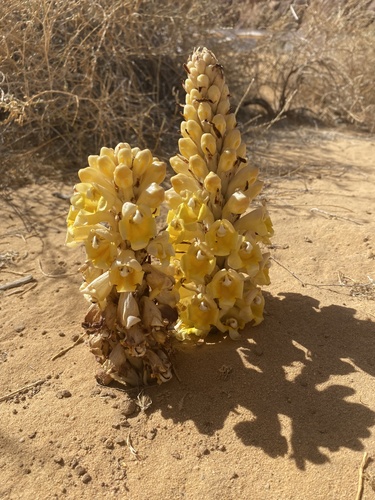
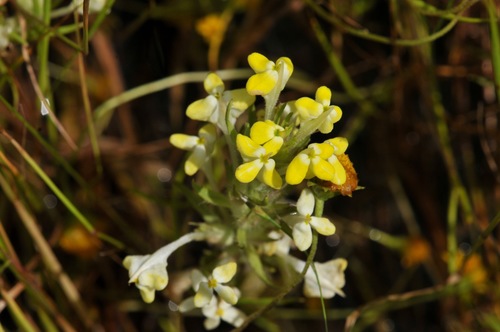
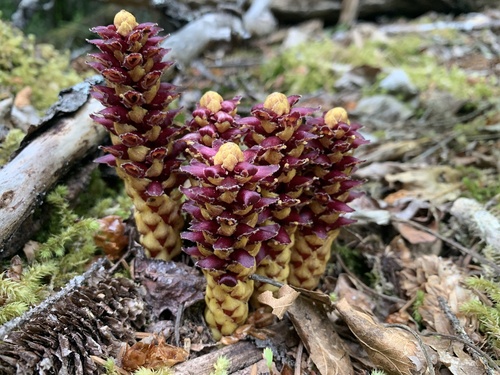
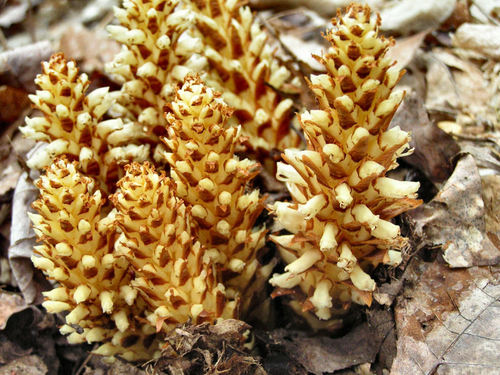
Conopholis americana (L.) Wallr. is a parasitic plant that grows on the roots of woody plants, most commonly oaks of the genus Quercus and beech of the genus Fagus. The only part of this plant that is typically visible is its cone-shaped inflorescence, which emerges above ground during spring. The entire above-ground structure is yellowish when young, and turns brown as it matures. It reaches a height between 10 centimeters (4 inches) and 20 centimeters (8 inches). This plant grows on roots in wooded ravines, and is found in every U.S. state east of the Mississippi River. Though it has a wide distribution, it is an uncommon species. It is native to the Nearctic region, specifically North America: in Canada, it occurs in Nova Scotia, Ontario, Quebec, and British Columbia; in the United States, it occurs in Connecticut, Indiana, Maine, Massachusetts, Michigan, New Hampshire, New Jersey, New York, Ohio, Pennsylvania, Rhode Island, Vermont, West Virginia, Illinois, Wisconsin, Alabama, Delaware, Florida, Georgia, Kentucky, Maryland, North Carolina, South Carolina, Tennessee, and Virginia. It is classified as a vulnerable species in New Hampshire and Vermont, and as an imperiled species in Rhode Island and Delaware. After flowering, each flower develops into a seed capsule that is longer than it is wide, and holds many small seeds. The plant spreads to new areas through self-seeding.