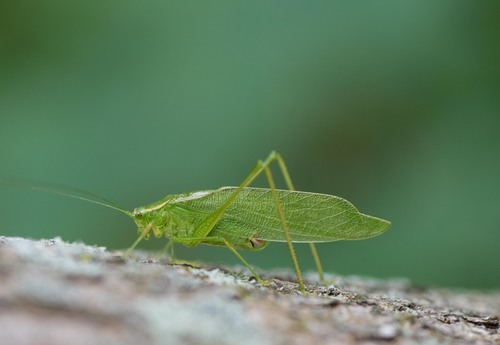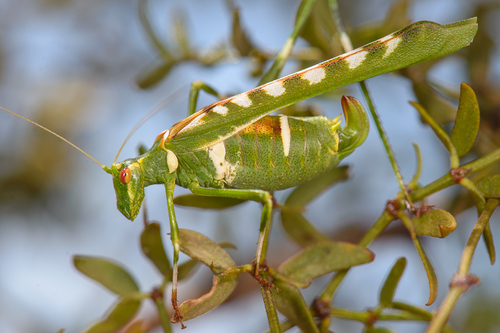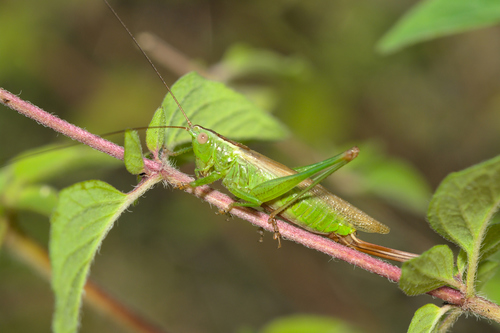
About Conocephalus fuscus (Fabricius, 1793)
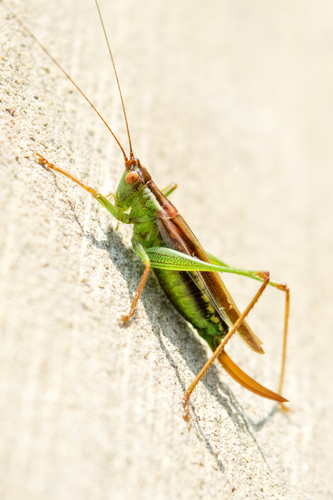
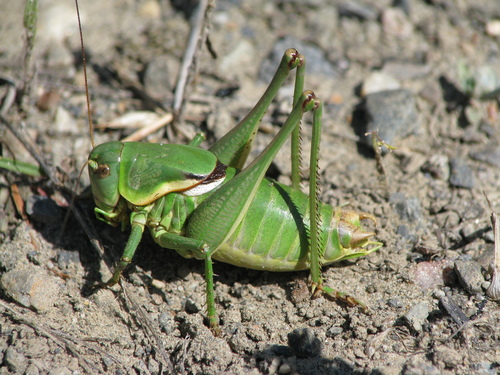
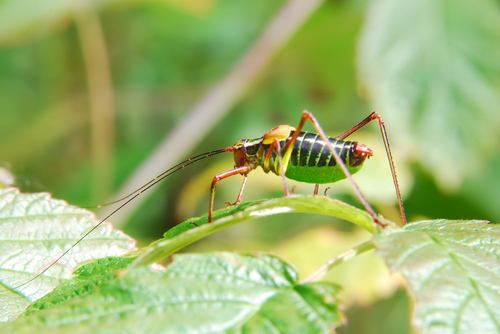
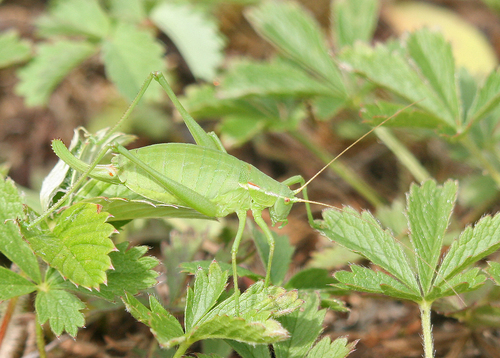
As a member of the bush-cricket family, Conocephalus fuscus shares the group's general body traits: like all bush-crickets, its body is protected by an exoskeleton, divided into three distinct sections (head, thorax, and abdomen). The top thorax segment, called the pronotum, is saddle-shaped and serves a primary protective function. All bush-crickets have large hind legs adapted for jumping, and biting mouthparts that aid in gripping and defense. Key characteristic traits of the bush-cricket family are antennae that are typically longer than the entire body, and a straight, sword-shaped ovipositor that females use to lay eggs. When mature, C. fuscus has a body length of 16–22 millimetres (0.63–0.87 in). Its hind wings are longer than its forewings, and both wing pairs extend past the tip of the abdomen. A distinct dorsal stripe runs down the thorax, covering the head and pronotum, which measures 12–17 millimetres (0.47–0.67 in) long. Adult C. fuscus have a slender grass-green body, brown wings, a brown ovipositor, a reddish-brown abdomen, and a dark-brown stripe edged with white near the thorax. Nymphs have slightly different colouration, with a light-green body and a black stripe edged with white. C. fuscus is a wing-polymorphic species. Most wing-dimorphic tettigoniids have both a short-winged (brachypterous) form and a long-winged (macropterous) form. Since C. fuscus is already classed as a long-winged species, its alternative wing form is extra-long-winged, with wings up to one third longer than those of typical individuals. A 1982 experiment by Ando and Hartley, which studied embryonic development in this species, found that an individual's tendency to develop into one wing morph or the other depends on population density: crowding induces development of extra-long-winged individuals in this species. Wing dimorphism in C. fuscus affects not just wing length, but also flight ability, dispersal, and reproductive capability. Juvenile hormone is responsible for wing polymorphism in orthoptera, and is known to influence the trade-off between wing morphology and reproductive capability. C. fuscus is found in parts of France, Italy, and the Netherlands, and has its largest population presence in the United Kingdom. When the species was first recorded in Britain in the 1940s, it was restricted to the South Coast. In the 1980s, it experienced dramatic population growth, and its range expanded more than 150 miles over 20 years. Today, the long-winged conehead is found in northwestern parts of the UK beyond the River Thames, and extends as far west as Wales. Global climate increase over recent decades has had a significant impact on this species' spread. Its northward range expansion aligns with global temperature increases driven by the greenhouse effect. All species adjust their breeding ranges by expanding or contracting in response to climate changes, and expanding into a realized niche when favourable conditions become available is advantageous for a species. In the 1950s, the northern hemisphere climate began cooling, leading to longer winters in southern Europe, which kept long-winged coneheads restricted to the southern UK, where they were first recorded, for a period. In 1975, the effects of greenhouse gases began to offset the cooling from previous decades. As the UK climate gradually warmed, long-winged coneheads started expanding their range further north. Major expansion did not occur until 1980, when global warming caused a significant temperature increase in the northern hemisphere. Since 1980, temperature has risen linearly by 0.13 °C (0.23 °F) ± 0.03 °C (0.05 °F) per decade, with the greatest impact occurring between 40°N and 70°N latitude. This latitudinal region includes the United Kingdom and southern Europe, which explains why the long-winged conehead, along with other European fauna, has responded most strongly to climate warming and expanded its range. A second factor driving this expansion is the existence of extra-long-winged individuals within the species. Populations at the northern edge of the range have a higher proportion of extra-long-winged (macropterous) individuals than populations in the range core. Ando and Hartley (1982) found macropters are more active and capable of sustained flight. Typical long-winged individuals only fly for short periods when disturbed, and more often seek cover. Simmons and Thomas (2004) also recorded a difference in flight capability between range populations. Individuals from border populations can fly up to four times longer (an average 16.7 km / 10.4 mi ± 2.3 km / 1.4 mi) than those from the range core (an average 4.2 km / 2.6 mi ± 0.8 km / 0.50 mi). This suggests there may be genetic differences between the two range populations, and that the effect of density on phenotype development is a plastic response, but this evidence is not definitive. It is clear that macropterous individuals have a selective advantage due to their ability for sustained flight, which allows them to form new colonies and colonise newly suitable habitats further north. This expansion benefits the whole species and its individual members. As the species expands its overall range, individuals can take advantage of unoccupied territory that previously had an unsuitable climate. Individuals in newly colonised areas do not need to compete for resources like food and shelter, so they can devote more time and energy to ensuring the reproductive success of their offspring and propagating their own genes. This is especially beneficial for extra-long-winged individuals, which experience a reproductive trade-off linked to their wing morphology. C. fuscus shares the same general habitat as many other bush-cricket species. It lives in grassy meadows, woodlands, dry heaths, and among coarse vegetation. It can also be found near water, in reed beds, marshes, or bogs. This species prefers warm climates, as shown by its recent northward dispersal driven by increasing global temperatures. C. fuscus is active during the day, and its main form of locomotion is walking. It uses its large hind legs for jumping when threatened by predators. C. fuscus has a univoltine life cycle, meaning it produces only one generation of offspring per year. In late summer, females lay eggs in the stems of grasses. They first bite a hole into grass or reed stems, then insert their eggs using their ovipositors. Eggs develop over the winter, and nymphs begin to emerge in mid-May, reaching adulthood between July and late October. Experiments by Ando and Hartley (1982) and Simmons and Thomas (2004) confirm a trade-off between wing morphology and reproductive ability. Macropterous individuals have lower overall fecundity (fertility) than typical long-winged individuals. A female's body length correlates with how much her abdomen can swell to hold the eggs she carries. Macropterous females are shorter than typical long-winged morphs, so they carry fewer eggs. While the total number of eggs stored in the ovaries is the same for both phenotypes, extra-long-winged individuals have significantly fewer eggs in active development at any given time. Lower fecundity in macropterous females is mostly due to a pre-oviposition period (the time between an adult female emerging and starting to lay eggs) that is more than twice as long as that of typical long-winged morphs. A second contributing factor is the lower oviposition rate macropterous females have during the first half of their egg-laying period, which means they never catch up to the normal egg-laying rate. Delayed maturation and lower egg production reduce the extra weight the insect carries, allowing it to fly for longer periods. The improved dispersal and flight capability of macropterous individuals gives them a higher chance of finding new habitat and colonising new territory, at the cost of reduced reproductive ability. This cost does not outweigh the benefit of relocating to an area with abundant space and resources. Because of this, further distribution changes can be expected if global temperatures continue to rise and areas further north become suitable habitats for C. fuscus.