About Conocarpus erectus L.
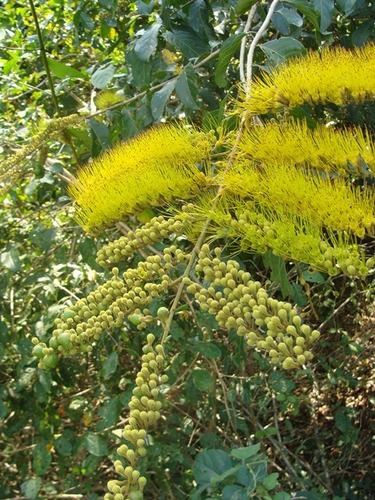
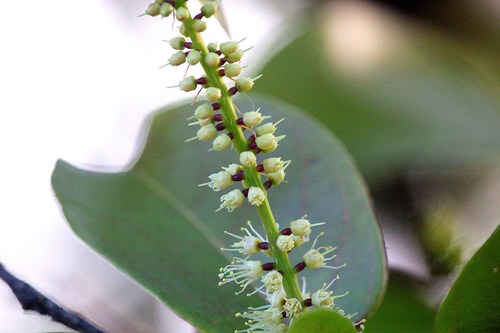
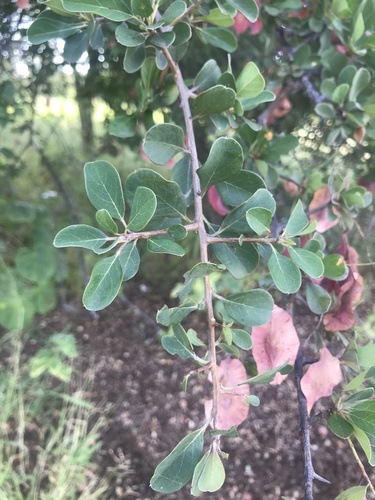
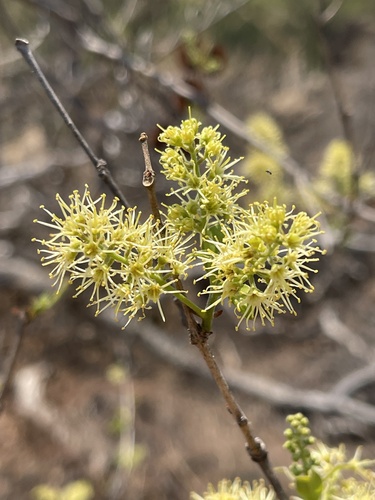
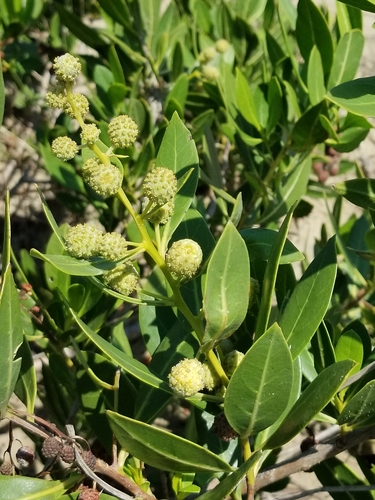
Conocarpus erectus L. is most commonly a dense, multi-trunked shrub that reaches 1 to 4 meters (3.3 to 13.1 feet) in height. It can also grow into a tree up to 20 meters (66 feet) or taller, with a trunk that can reach 1 meter (3.3 feet) in diameter. The United States National Champion green buttonwood, a specimen of this species, measures 35 feet (11 meters) tall, has a 70-foot (21-meter) spread, and a trunk circumference of 207 inches (530 centimeters). Its bark is thick, with broad plates of thin scales that range in color from gray to brown. Its twigs are brittle, and are angled or narrowly winged in cross-section. Its leaves are alternately arranged, simple, and oblong, measuring 2 to 7 centimeters (0.79 to 2.76 inches) long, rarely reaching 10 centimeters (3.9 inches) in length, and 1 to 3 centimeters (0.39 to 1.18 inches) wide. Each leaf has a tapering tip and an entire (smooth) margin. The upper leaf surface is dark green and shiny, while the lower surface is paler and covered in fine silky hairs; each leaf also has two salt glands at its base. The flowers of Conocarpus erectus lack petals and are button-like, which gives the species its common names. They are 5 to 8 millimeters (0.20 to 0.31 inches) in diameter, and are produced in stalked panicles that hold 35 to 56 flowers. The fruit is a cluster of small, scaly, red to brown, two-winged cone-shaped seeds that measures 5 to 15 millimeters (0.20 to 0.59 inches) long. When the seed heads ripen, they burst, and the seeds are dispersed by water. This species grows on shorelines in tropical and subtropical regions of the Americas and West Africa. It is most commonly found growing in brackish water in tidal lagoons and bays, but it can also grow in inland habitats; it has been recorded at altitudes as high as 745 meters (2,444 feet) in Costa Rica. Known locations include Florida, Bermuda, the West Indies, Central America and South America (from Mexico to Brazil on the Atlantic Coast, and Mexico to Peru on the Pacific Coast), as well as the western African coast. It has been introduced to Kuwait and Western Australia, because it readily thrives in high temperatures and can absorb brackish water. Conocarpus erectus is used as an ornamental plant and for bonsai. Its silvery-leaved variety sericeus is especially valued for landscaping. It is an important host plant for epiphytes. Due to ornamental planting, it has become naturalized in Hawaii. It has been widely used for landscaping in Kuwait, where it has become the most abundant tree or shrub. Its wood is sometimes used to make cabinets; it is difficult to work with, but takes a smooth finish. The wood is also used as firewood, and is reported to be good for smoking meat and fish because it burns very hot and slowly. It can also be used to produce high quality charcoal. The bark of this species is high in tannin, and has been harvested commercially for this compound.