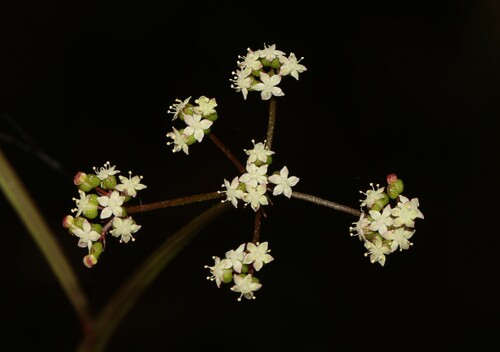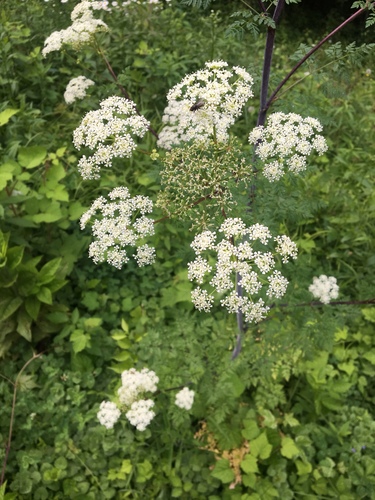
About Conium maculatum L.
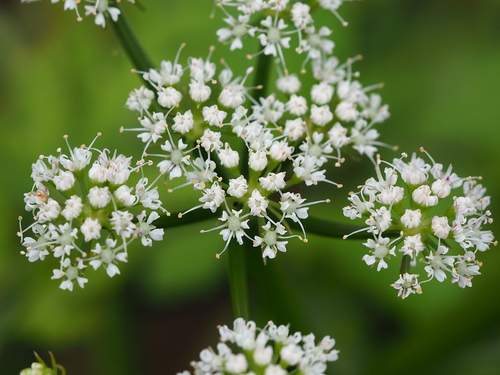
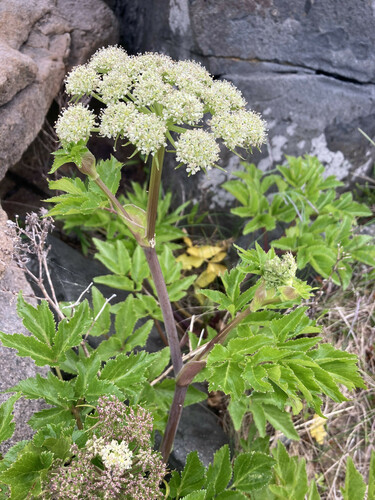
Conium maculatum L. is a herbaceous flowering plant that usually grows as a biennial, though it may occasionally grow as a perennial. It is a nitrophile. In its second year of growth, it produces coarse, frequently branching, hollow flower-topped stems that grow 0.5 to 3 m (1.6 to 9.8 ft) tall; stems are hollow except at the nodes (leaf attachment points), and are typically spotted or streaked with purple. In its first year, the plant produces no stems, and instead grows a large rosette of leaves at ground level. All parts of the plant are glabrous (hairless), and lower plant parts sometimes carry a light coating of blue-grey natural waxes. It has a long, white, fleshy, usually unbranched taproot. Its leaves are one- to three-pinnate, finely divided and lacy. Lower leaves are two-pinnate or more, while upper leaves are one-pinnate and often only partially divided. Lower leaves are larger than upper leaves, with an overall broad triangular shape, reaching 30 to 60 cm (12 to 24 in) in length. Leaflets grow in pairs on opposite sides of the central leaf veins. Poison hemlock has small white flowers, each with five petals and no sepals. Flowers have white stamens and a style around 0.5 mm long. Flowers are arranged in umbrella-shaped clusters called umbels, which measure 2 to 5 cm (0.8 to 2.0 in) across, and grow both at the tips of stem branches and from leaf axils (the angle where a leaf stalk attaches to the main stem). Each umbel is a rounded cluster of 10 to 20 rays (short stalks 1 to 3.5 cm long) that radiate out from the umbel center. Its fruit is a schizocarp, which easily splits into two parts. Fruits are 2.5 to 3.5 mm long, gray-brown, ridged, and egg-shaped. Poison hemlock is native to Europe, Central Asia, and the Mediterranean region, and occurs in many counties of the British Isles, including Northern Ireland. It has become naturalized in Asia, North America, Australia, and New Zealand. It is sometimes found near rivers in southeast Australia and Tasmania, where it is considered an invasive species. In the United States, infestations and human contact with the plant are sometimes newsworthy due to its toxicity. It spreads rapidly by seed, and is difficult to eradicate because seeds can remain dormant for up to 6 years. Poison hemlock commonly grows in poorly drained soil, especially near streams, ditches, and other wet areas. It also grows on roadsides, at the edges of cultivated fields, in waste areas, in damp soil, and on drier rough grassland and disturbed ground. It serves as a food plant for the larvae of some Lepidoptera species, including the silver-ground carpet moth and the poison hemlock moth (Agonopterix alstroemeriana). The poison hemlock moth has been widely used as a biological control agent for poison hemlock. It is a food source for caterpillars of the North American black swallowtail butterfly, though these caterpillars have better survival on two other introduced plants, wild carrot and parsnip. Similarly, the anise swallowtail (Papilio zelicaon) of western North America relies heavily on non-native plants including poison hemlock and fennel in urban and suburban areas of California. Poison hemlock was introduced to the United States from Europe in the 1800s as an ornamental garden plant under the name "winter fern". The poison hemlock moth was introduced alongside it, and has since spread across most of the United States, but its effectiveness in killing poison hemlock is limited. It is possible that the plant is adapting to its predators by becoming more toxic. All parts of poison hemlock are poisonous, but the total concentration of toxic alkaloids varies widely depending on plant age and plant part. The roots of young first-year plants contain only trace amounts of poison, or none at all. Seedling leaves have lower poison levels than slightly older plants. In the spring of the second year, leaves are highly toxic, though they are less poisonous than the plant's flowers or seeds later in the growing season. Hollow stems remain deadly for up to three years after the plant dies. Drying the plant causes it to lose a large portion of its toxic compounds. Plants grown in sunny conditions can be twice as poisonous as plants grown in wet, cloudy conditions. The main toxic alkaloids produced by the plant are coniine and γ-coniceine (gamma-coniceine). Poisoning has been reported in many animal groups, including pigs, bovids, turkeys, equines, rabbits, cats, and dogs. Songbirds are less sensitive to the toxin, but have been reported to become toxic after absorbing coniine from hemlock. Ingestion of 150–300 milligrams of coniine, roughly equivalent to six to eight hemlock leaves, can be fatal for adult humans. Grazing animals are most likely to be poisoned in the spring when other forage is scarce. Poisoning can also occur when hemlock becomes mixed into grain, hay, or silage. Poison hemlock ingestion typically causes severe, fatal seizures in cattle. Even very small amounts can cause birth defects if ingested between 40 and 100 days of gestation. Medieval writers suggested hemlock as one possible cause of coturnism, an illness that occurs after eating common quail in certain seasons. Modern research points to annual woundwort (Stachys annua) as the most likely source of the toxin, though the actual cause is still unknown. In the high mountain regions of Georgia, hemlock leaves were historically eaten as a spring food after long winters, requiring careful preparation through multiple changes of cooking water. Other toxic plants including cow parsnips (Heracleum species), potatoes, and lilies were prepared this way as well. Local people interviewed by ethnobotanical researchers were aware of the plants' poisonous nature, and reported that this practice has largely died out as improved roads have increased access to cultivated foods in markets. Poison hemlock was used as a medicine in ancient times, though great care was required due to its toxicity. In medieval Europe, it was only given as a treatment for rabies (the bite of a mad dog), mixed with betony and fennel seed in wine. Later, it was used as a last-ditch attempt to treat poisoning from virulent toxins such as strychnine. In the 1400s and 1500s, European monks roasted the root and applied it externally to the feet, hands, and wrists to relieve gout pain. Prominent herbalist Nicholas Culpeper wrote that the plant was under the astrological control of Saturn, giving it a cold and dangerous character, and recommended external use for inflammation and swelling, and roasted root applied to the hands for gout. In the Victorian language of flowers, hemlock flowers carried the meaning "You will be the death of me". From 1864 to 1898, poison hemlock was officially listed as a medicinal drug in the London and Edinburgh pharmacopoeias. Its last listing in an official British pharmaceutical publication was in the 1934 British Pharmaceutical Codex.