About Congea tomentosa Roxb.
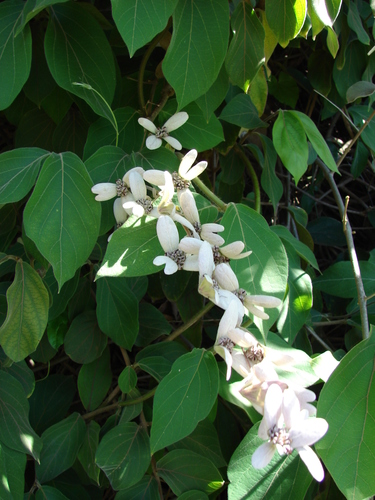
Congea tomentosa Roxb. is a large tropical evergreen vine, commonly known as wooly congea, shower orchid, or shower of orchid. Despite its common orchid-related names, it is not closely related to true orchids. In Spanish it is called lluvia de orquideas or terciopelo, krua on in Thai, and rong bao teng in Chinese. It is native to Myanmar and Thailand, and can also be found across other parts of South Asia, including Laos, Vietnam, Kedah in Malaysia, Yunnan in China, Bangladesh, and the Indian states of Assam, Manipur, Tamil Nadu, and West Bengal. Its native habitat is mixed forests located 600 to 1200 meters above sea level. This tropical vine has become naturalized in other regions, including the islands of the Caribbean, southern Florida, and southern California. In the United States, wooly congea can be grown outdoors in USDA zones 10 and 11, and it cannot tolerate frost. In cultivation, the plant reaches 3 to 5 meters (9.8 to 16.4 feet) in length, and grows even larger in its native habitat. Fine, downy hairs cover the plant’s stems, leaves, and bracts. The leaves are light green, 6 to 8 inches (15 to 20 centimeters) long, quite attractive, evergreen, and marked by prominent veins. They are arranged in opposite pairs on the stem. The actual flowers of the plant are tiny and inconspicuous, growing in the center of three showy white or violet bracts that measure 1 inch (2.5 centimeters) long and look like velvety propellers. It produces sprays of these showy bracts from late winter through spring. Over the course of several weeks, the bracts gradually change color, shifting through pink, lavender, and finally turning grey. For cultivation, Congea tomentosa can be grown as a trailing or climbing vine, or pruned to grow as a shrub. In climates that experience frost, it is grown inside a warm greenhouse or conservatory. When grown indoors, it should be potted in soil-based potting compost, given maximum light with shade from direct sun, provided with supports for its stems, and pruned after flowering to keep its size contained. When grown outdoors, it should be planted in moisture-retentive, fertile soil in full sun. It can be propagated from either seed or semi-ripe cuttings, and bottom heat is recommended for both propagation methods. The plant is easy to grow in almost any soil type, and should be watered regularly. Whole branches with flowering clusters of this plant are used in cut flower arrangements.