About Commiphora africana (Rich.) Engl.
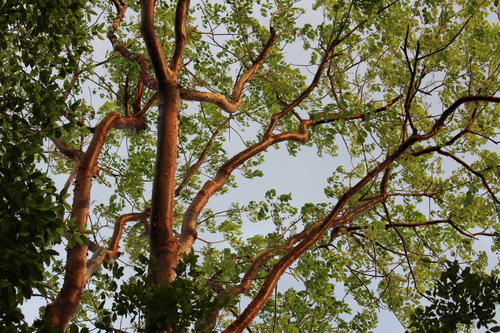
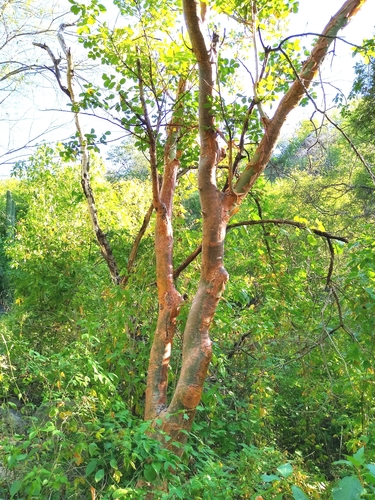
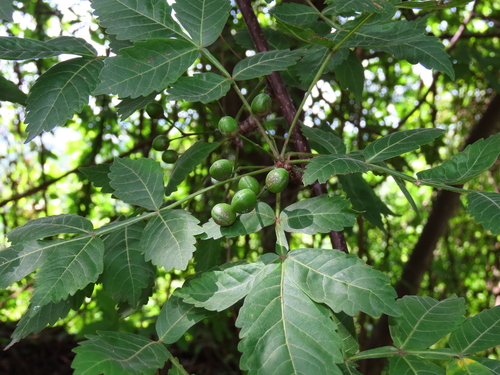
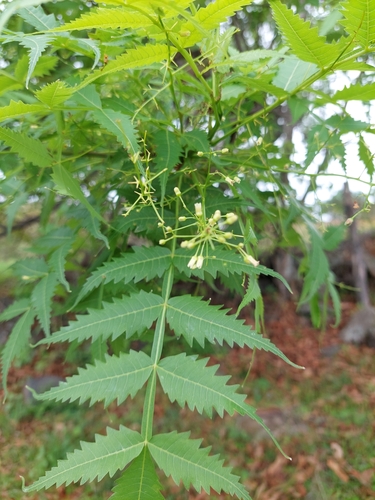
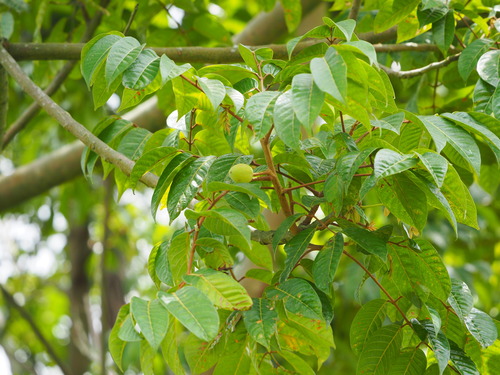
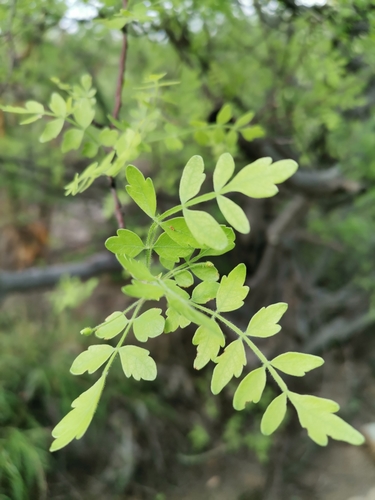
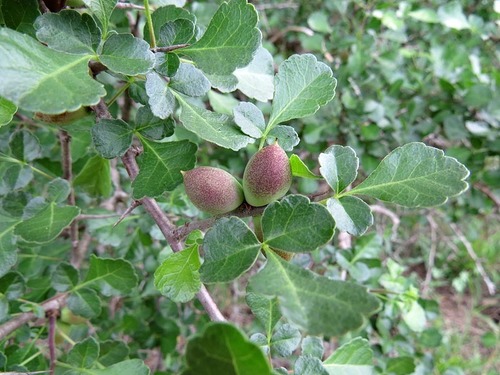
Commiphora africana, commonly known as African myrrh, is a small deciduous tree in the Burseraceae family, a family related to Anacardiaceae. It is widely distributed across sub-Saharan Africa, occurring in Angola, Botswana, Burkina Faso, Chad, Eswatini, Eritrea, Ethiopia, Kenya, Mali, Mauritania, Mozambique, Namibia, Niger, Senegal, Somalia, South Africa, Sudan, Tanzania, Uganda, Zambia and Zimbabwe. On sandy soils, this species sometimes forms pure stands that can be considered a distinct plant community or association. Closely related to C. glandulosa, C. africana typically grows to around 5 meters tall, and its branchlets often end in spines. Its bark is grey-green and peels to reveal a shiny surface; when damaged, the bark turns red and oozes bdellion, a clear, edible, aromatic gum. The genus name Commiphora translates to 'gum-bearing'. The leaves are trifoliate, consisting of one large terminal leaflet and two small side leaflets, with blunt teeth. Like leaves of most Commiphora species, they are pleasantly aromatic when crushed. Its fruits are reddish, about 6 to 8 millimeters across, and split open when ripe. Inside is a hard, black seed held by a pseudo-aril or mericarp with four red lobes shaped like fingers, which resembles the clasps that hold a jewel in a brooch or ring setting. The fruits of this tree are edible. Humans often chew its succulent, sweet roots, and camels and goats favor its new leaves, especially at the start of the dry season. This tree is extremely sensitive to atmospheric humidity, and will open its leaf buds at the first sign of moisture-carrying winds. As a result, it is the first tree to grow new leaves when the wet season arrives, and stays consistently green through the entire rainy period. In the Sahel, only Salvadora persica shares this striking fresh green appearance during the wet season. Its leaves only remain as long as moist air persists, and dry out immediately after the rainy season ends. At this point, the foliage changes color to a distinctive, remarkable golden hue. C. africana takes advantage of any wet period to complete its full cycle of leafing, flowering, and fruiting, then enters dormancy during unfavorable conditions. Even with this adaptation, its foliage does not have any of the traits typically seen in drought-adapted plants. Herdsmen in the northern Sahel follow rainfall patterns and the leaf emergence of C. africana, constantly moving their herds to find new browsing areas for their animals. This species is the preferred food plant for the beetle Diamphidia; the larva of this beetle is used to make a potent arrow poison. C. africana is especially well-suited for use as a live fence. Different parts of the tree are used to treat a wide variety of health conditions: fruits are used for typhoid fever and stomach issues, bark for malaria, resin for convulsions and for covering and disinfecting wounds. Burnt resin is used as an insecticide and an aphrodisiac. Its soft, termite-resistant wood is used to carve domestic utensils, musical instruments, and general-purpose items. An edible oil is also extracted from the tree, and parts of the tree show strong fungicidal properties.