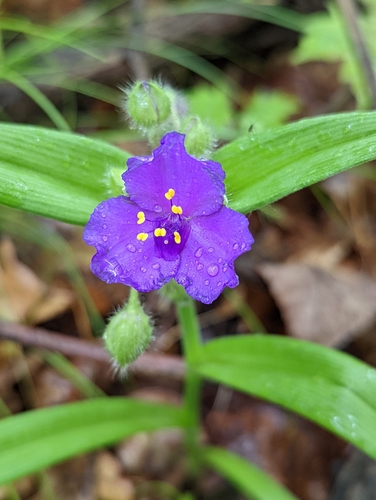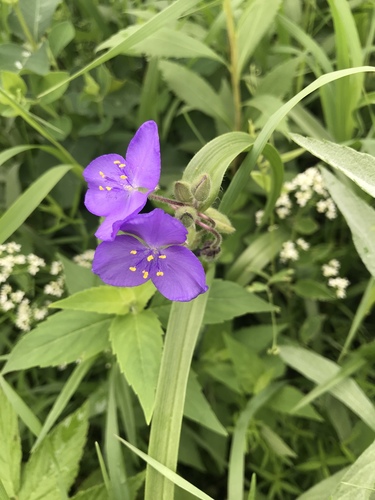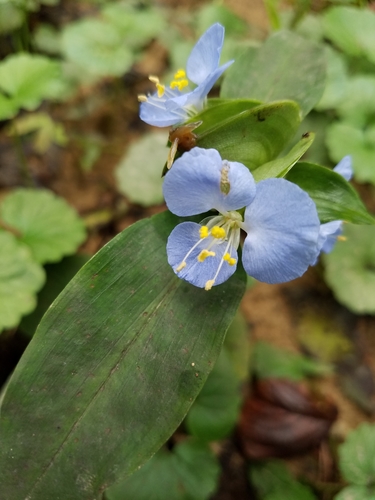
About Commelina virginica L.
Commelina virginica, commonly known as the Virginia dayflower, is a perennial herbaceous plant belonging to the dayflower family. It is native to the mideastern and southeastern United States, where it typically grows in wet soils. Most members of the genus Commelina have thin, fibrous roots, but the Virginia dayflower is relatively unique within its genus for having a perennial rhizome. This plant was first formally described by Carl Linnaeus in the 1762 second edition of his publication Species Plantarum. A phylogenetic study used two commonly applied gene regions for inferring evolutionary relationships: the nuclear ribosomal DNA region 5S NTS and the chloroplast region trnL-trnF. This study suggested that Commelina virginica is most closely related to two African species: Commelina capitata and Commelina congesta. The statistical support for this proposed relationship was low, despite the fact that these putatively related species do share some unique morphological traits. Both C. virginica and C. capitata have red hairs at the top of their leaf sheaths, an unusual trait within the genus. C. virginica and C. congesta both have clustered inflorescences borne on very short stalks.