About Colus hirudinosus Cavalier & Séchier
Scientific name: Colus hirudinosus Cavalier & Séchier
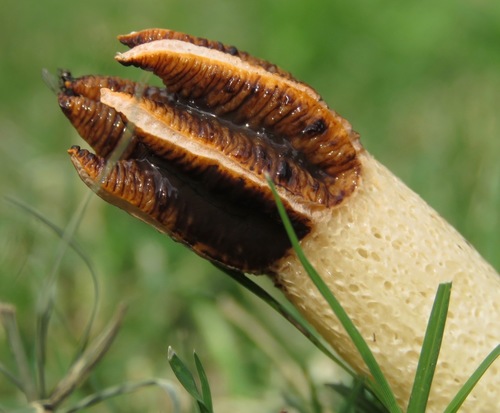
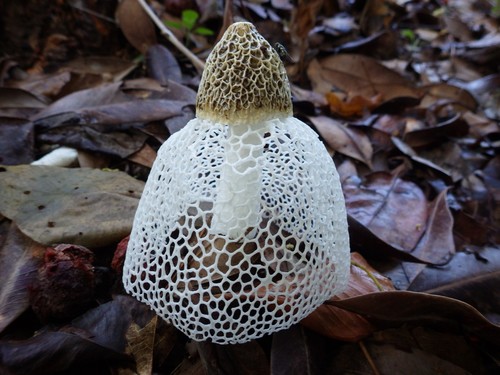
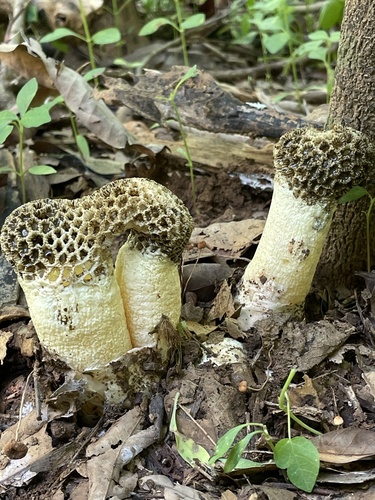
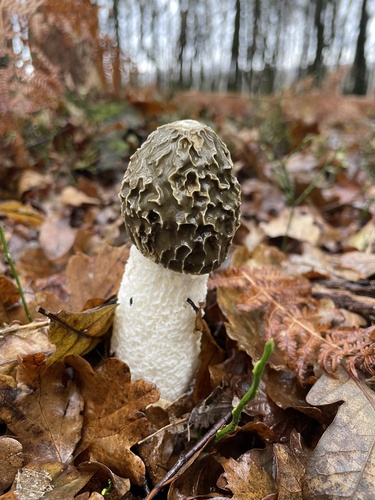
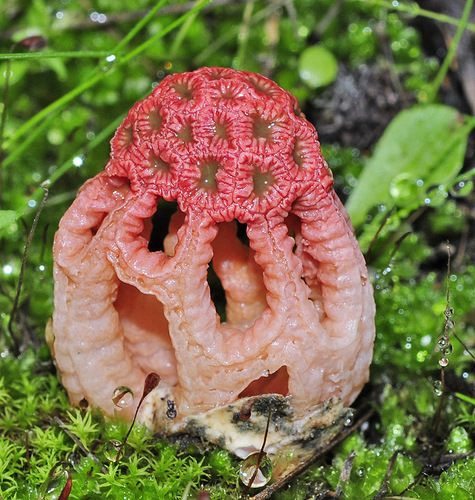
Description: Fruit bodies start developing as an egg-like structure. This roughly spherical egg measures about 1 cm (0.4 in) in diameter, and is white, or mottled with brown on its upper portion. One or more thin white rhizomorphs attach to the underside of the egg. After emerging from the egg, the fruit body has a short, thick stalk that grows between four and six vertical, arching columns. These columns are pink in their lower section, and gradually deepen to red near the top, with a corrugated surface texture. The columns often fork near the top into additional branches that support a lattice-like, or clathrate dome. The meshes of the fertile net are roughly polyhedral, and there is an abrupt transition between columns and lattice. The olive-green gleba is held on the bottom of, and in between the meshes of the clathrate dome, and on the inner side of the upper arms. This species has a fetid odor similar to feces, which attracts flies that visit the mushroom, consume the gleba, and carry spores to new locations to germinate. Spores produced by C. hirudinosus are rod-shaped, hyaline (translucent), and measure 3.5–6.5 by 1–1.75 μm. Structurally, the spongy columns are made of a double layer of tubes: one large inner tube, and two or three outer tubes. Remnants of the egg tissue form a volva that encloses the base of the fruit body.
Habitat and distribution: Colus hirudinosus is believed to be saprobic, meaning it gets nutrients by decomposing dead or decaying organic matter. Fruit bodies grow in manured soil and sand, and frequently also grow under Cistus shrubs. This frequent association has led some researchers to suggest the fungus may also act as a facultative endophyte. The species is most widespread in Europe, especially in Mediterranean countries including Corsica, Cyprus, France, Greece, Italy, Portugal, Israel and Spain, and it is found as far north as Switzerland. In Africa, it has been reported from Algeria and Nigeria. It has also been found in Asia and Australia. In the Caribbean, it is only known from Jamaica.