About Columnea consanguinea Hanst.
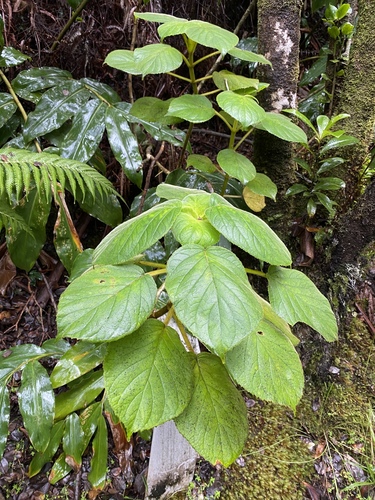
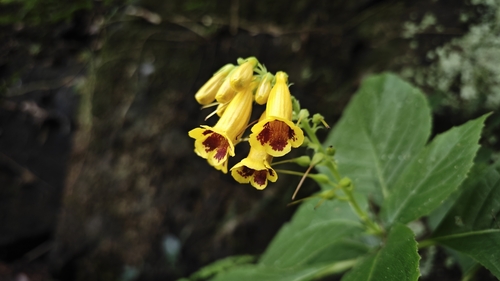
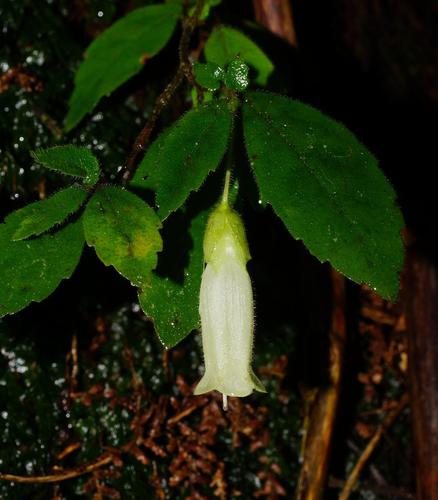
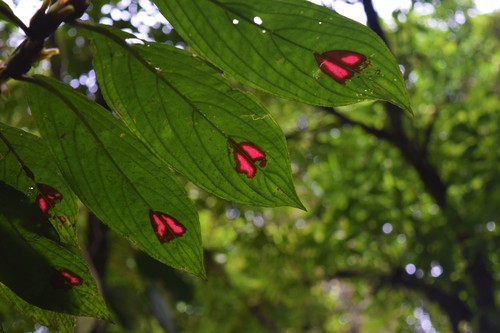
Columnea consanguinea Hanst. is a shrub-like herb. Its stems are unbranched, pale brown, hairy, and reach a maximum length of around 1 to 1.2 meters (3.3 to 3.9 feet). Leaves grow on stalks about 1 cm (0.39 in) long, and are arranged oppositely along the stems. One leaf in each opposite pair is much smaller than the other, so the leaves appear to be arranged alternately. The larger leaf blades are lanceolate with uneven sides. They measure 12 to 16 centimeters (4.7 to 6.3 inches) long and 3 to 6 centimeters (1.2 to 2.4 inches) wide. The upper leaf surface is smooth, while the lower surface is slightly hairy. Leaves are mostly dark green, with distinctive translucent bright red heart-shaped markings on the underside; these markings appear as yellow-green areas on the upper leaf surface. The smaller leaves from each opposite pair are only 1 to 2.5 cm (0.39 to 0.98 in) long and around 0.8 cm (0.31 in) wide. They sit flush against the stems and look like small sheaths. Small tubular flowers grow from the stem near the base of the leaves. They are about 3 cm (1.2 in) long and 0.8 cm (0.31 in) wide. Petals are pale yellow, while the calyx ranges from green to red. This species blooms year-round, and produces many small yellow fruits. Columnea consanguinea is very similar to Columnea florida; C. florida also has red heart-shaped leaf markings, but can be distinguished by the pectinate, teeth-like edges of its flower calyces. Columnea consanguinea grows in tropical rainforests at altitudes between 300 and 1,900 meters (980 to 6,230 feet) above sea level. It can grow either terrestrially on the ground, or epiphytically on tree trunks. It is endemic to Colombia, Costa Rica, Ecuador, Nicaragua, and Panama. Columnea consanguinea has relatively small, plain flowers. To attract its main pollinator, the nectarivorous green-crowned brilliant hummingbird (Heliodoxa jacula), it uses the markings on its leaves instead. When sunlight filters through the translucent leaf patches, the markings turn a bright red similar to stained-glass windows. Hummingbirds, which have much better color vision than humans, are attracted to this red color, find the flowers to feed, and pollinate C. consanguinea in the process. The same leaf-marking pollination strategy is used by C. florida, which also bears red leaf markings.