About Colostygia pectinataria (Knoch, 1781)
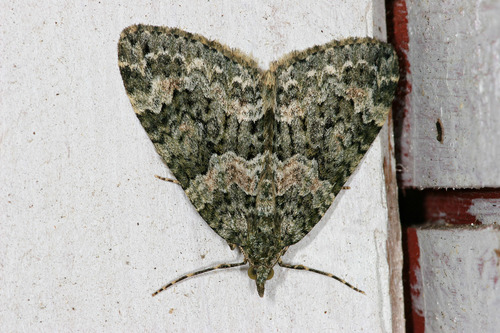
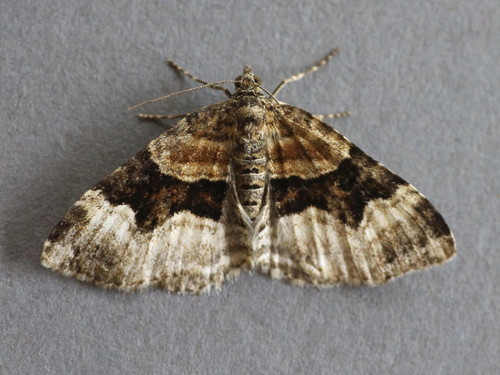
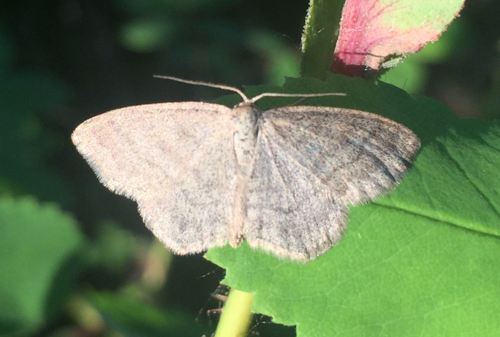
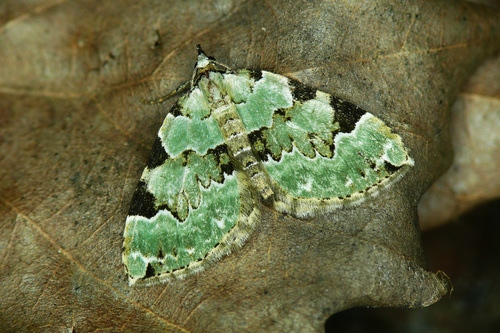
Colostygia pectinataria, commonly called the green carpet, is a Palearctic moth in the genus Colostygia of the family Geometridae. It was first formally described by August Wilhelm Knoch in 1781. The wingspan of this moth ranges from 22 to 28 millimetres (0.87 to 1.10 inches). The forewings have a strong base ground colour that varies from green to bluish-green. The colour pattern on the wings follows a distinct sequence: the small area near the wing base is brown-green; the following basal region is a brighter green; the wide discal region has strongly serrated outer edges, is dark green, and is bordered with white; the postdiscal region is whitish-green; and the marginal region is tinted brownish-green. There are two distinct blackish spots close to the costa, or front edge of the wing, and one spot on the inner edge. In older specimens, the green colouration of the wings can fade. Sometimes newly emerged adult moths have a whitish, yellowish, or pink base colour. The hindwings have a shimmering grey-white colour and carry faint lines. Male individuals have combed antennae, while female antennae are simple. The larva is stout, gnarled, and light grey-violet, with numerous small black spots, each of which bears a short, stiff brush-like seta. This species occurs across many different biotopes, including moors, marshy terrain, and forests. Larvae feed primarily on Galium, and will also feed on Rumex and Lamium. Adult moths fly at night between June and July, and are often attracted to artificial light. This Palearctic species ranges from the Iberian Peninsula across western and central Europe, including the British Isles, eastward to the Altai Mountains. It reaches as far north as the Arctic Circle in Fennoscandia; to the south, its distribution extends from the western Mediterranean to the Balkan Peninsula, the Black Sea region, and the Caucasus. In mountainous areas, C. pectinataria has been recorded at elevations over 2,000 metres (6,600 ft). It prefers habitats including bogs, forests, bushy forest edges, and damp heath areas.