About Colorhamphus parvirostris (Darwin, 1839)
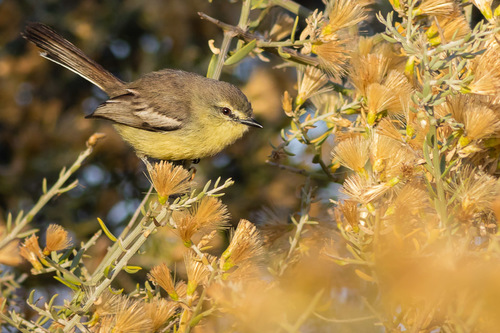
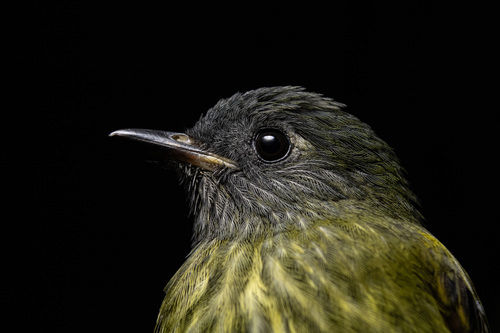
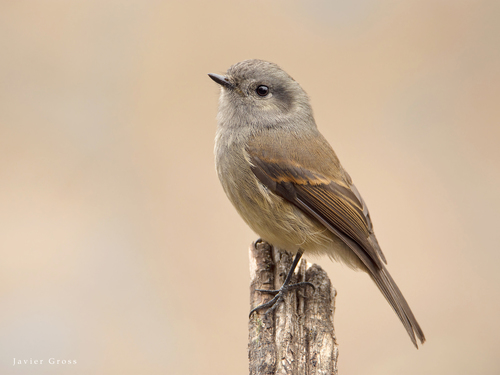
The Patagonian tyrant, scientifically named Colorhamphus parvirostris (Darwin, 1839), measures 12 to 13 cm (4.7 to 5.1 in) in length. The sexes have essentially identical plumage, though females sometimes have a darker throat than males. Adult Patagonian tyrants have a mostly gray head with a darker brownish gray crown and a blackish streak behind the eye. Their upperparts are olive-brown, and their wings are blackish brown with wide cinnamon edges on the coverts that form two distinct wing bars. Their tail is blackish brown. Their throat and underparts are grayish, with a yellowish wash covering the belly, flanks, and undertail coverts. They have a black iris, a black bill, and black legs and feet. Juveniles have a crown that matches the gray of the rest of the head. They have some rufous coloring in their upperparts, darker underparts, and a stronger yellowish wash than adults. This species is distributed from the Coquimbo Region of north-central Chile and the Neuquén and Río Negro provinces of southern Argentina, south all the way to Tierra del Fuego. During the breeding season, it almost exclusively lives in Nothofagus forest. During the non-breeding season, it can be found in Nothofagus forest, as well as a more diverse range of denser, more humid forest types, and also in urban areas, parks, and gardens. In elevation, it ranges from sea level to 1,800 m (5,900 ft) during the breeding season, and reaches up to 2,000 m (6,600 ft) at other times of year. There is one single documented record of this species at 2,700 m (8,900 ft).