About Colophospermum mopane (J.Kirk ex Benth.) J.Léonard
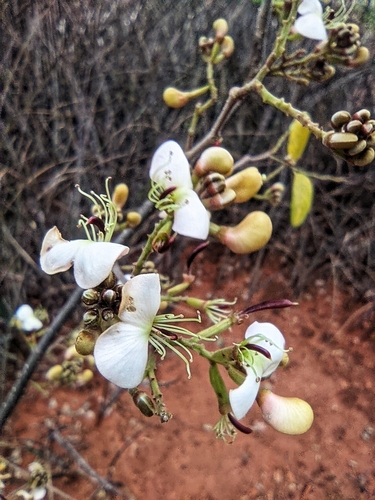
Colophospermum mopane prefers slightly acidic, deep, friable, permeable clay soil, but it also grows in shallow, poorly drained alkaline soils with high lime content, as well as in alluvial soils deposited by rivers. Where it grows, it is often the dominant tree species and frequently forms dense, homogeneous stands. Within the Zambezian region, tree height varies considerably: larger single-stemmed trees 10 to 15 m (33 to 49 ft) tall grow in open savannah woodlands on sandy alluvial soil, forming canopy woodlands. Zambia’s so-called "cathedral mopane" can even reach 18 m in height. By contrast, the same species grows as stunted multi-stemmed shrubbery 1 to 2 or 3 m (3.3 to 6.6 or 9.8 ft) tall on clayey soil or impermeable alkaline soil. These stunted growth forms are sometimes called "mopane scrub", and the shrubs never grow into taller trees. Poor drainage or limited water availability appears to be a factor causing stunting, though other potential causes have also been hypothesized. This tree does not grow well outside of hot, mostly frost-free areas that receive low to moderate annual rainfall, which can be as low as 100 mm per year, with an average annual rainfall of 400–500 mm. The mopane occurs on low-lying ground from 200 metres (660 ft) in Mozambique to 1,200 metres (3,900 ft) in Zimbabwe. Mopane wood is one of southern Africa's heaviest, with an average density of 0.990 to 1.230 g/cm³ (61.8 to 76.8 lb/cu ft) at 12% moisture. It is difficult to work due to its hardness, but it is naturally termite-resistant, which makes it one of the most preferred local timbers for construction. It has long been used for building houses and fences, as railway sleepers, and as pit props. Its termite resistance and rich reddish colour also make it popular for parquet flooring. Outside of Africa, mopane is growing in popularity as a heavy decorative wood. It is used for aquarium bogwood ornaments, driftwood-style decor for terrariums or gardens, and as bases for lamps or sculptures. It is also increasingly used to build musical instruments, particularly woodwinds. As suitable quality African blackwood (Dalbergia melanoxylon), which is traditionally used to make clarinets, becomes harder to source, mopane has filled this gap. Mopane wood is fairly oily, seasons very well with few splits or warps, and produces instruments with a warm, rich tone. Clarinets made from mopane are sold by manufacturers Schwenk & Seggelke, Wurlitzer, F. Arthur Uebel and Buffet Crampon. Mopane twigs have traditionally been used as chewing sticks to clean teeth, and the tree's leaves are used in folk remedies to heal wounds after ritual tooth extraction. Various parts of the tree including seeds, leaves, bark and roots are used in traditional medicine across southern Africa to treat a wide range of symptoms. Bark is used to make twine or rope and for tanning leather. The wood is also used to make charcoal and for braai cooking fuel. This tree is a major food source for the mopane worm, the caterpillar of the moth Gonimbrasia belina. These caterpillars are high in protein and are eaten by people; they are also rich in crude fats, and contain vitamins and minerals including iron, calcium, and phosphorus. Another edible caterpillar, that of Gynanisa maja (the speckled emperor moth, called chipumi in Bemba), also uses mopane as a host tree. When the tree is infested by the "mopane fly" or "mopane psyllid" (Retroacizzia mopani, synonym Arytaina mopani) which feeds on it, the tree produces an edible wax-like gum on its leaves called "mopane manna". This gum is collected and eaten by both humans and monkeys. Mopane is also a food plant for the wild silk moth Gonometa rufobrunnea. The cocoons of this moth are harvested for wild silk, which is used to make cloth. Harvesting mopane worms creates employment and acts as an income source for many rural women, who sell their harvest in villages, towns, or to traders. Mopane is also considered an important food resource for goat herding and animal husbandry, as goats can browse on the tree's leaves. Its leaves are also browsed by cattle and game animals including elephants, giraffes, water buffalos, and antelopes on game farms and in nature reserves.