About Colonia colonus (Vieillot, 1818)
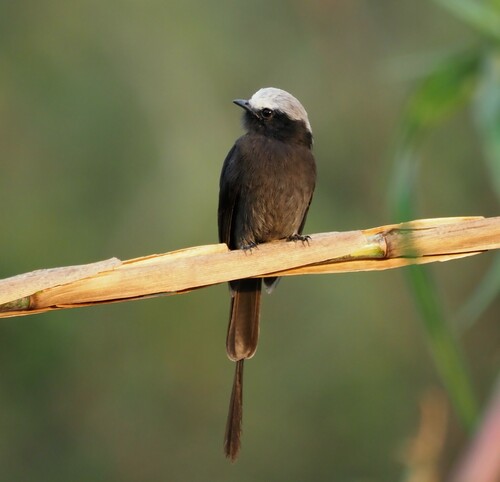
This species is the long-tailed tyrant, with the scientific name Colonia colonus (Vieillot, 1818). Male long-tailed tyrants measure 23 to 28 cm (9.1 to 11 in) in length, and females measure 18 to 22 cm (7.1 to 8.7 in); these measurements do not include the elongated central tail feathers. Adult individuals weigh 15 to 18 g (0.53 to 0.63 oz). Adult males of the nominate subspecies C. c. colonus are mostly dull black, with a white forehead and forecrown, a whitish rump, and a grayish black belly. Their central pair of tail feathers can extend up to 13 cm (5.1 in) beyond the other tail feathers, and have somewhat widened tips. These elongated feathers are often worn or broken. Adult females are paler and grayer than males, with a darker crown, grayer rump, and shorter tail streamers; their belly is mottled with white. Juveniles are a paler sooty gray than adults, with a faint whitish stripe around the crown, a pale gray belly, and central tail feathers that project only slightly beyond the other tail feathers. Other subspecies of the long-tailed tyrant differ from the nominate subspecies and from each other as follows: C. c. leuconota is overall sootier gray than the nominate, with a darker crown, smaller bill, and a grayish white stripe down the middle of the back. C. c. fuscicapillus has a darker back than the nominate, with a pure white rump. C. c. poecilonota is the largest subspecies; it is blacker than the nominate, with a black-streaked ashy gray crown, a white stripe down the middle of the back, and a heavier bill. C. c. niveiceps is similar to the nominate, except for having a silvery gray crown. All subspecies have a dark iris, a short, wide, black bill, and black legs and feet.
The long-tailed tyrant has a disjunct distribution, with subspecies occupying separate ranges as follows: C. c. leuconota is found on the Caribbean slope from Olancho and Gracias a Dios departments in northeastern Honduras, south through Nicaragua and Costa Rica, through Panama on both the Caribbean and Pacific slopes, east into north-central Colombia, and south through western Colombia into Ecuador as far as northern Guayas and Los Ríos provinces. C. c. fuscicapillus is found from Colombia's Cundinamarca Department, south along the Eastern Andes and the eastern slope of the Ecuadorean Andes into far northeastern Peru's Amazonas and Loreto departments. C. c. poecilonota is found in Venezuela on Cerro de la Neblina in far southern Amazonas state, and from Venezuela's central Bolívar state east through the Guianas. C. c. niveiceps is found from southern Zamora-Chinchipe Province in southeastern Ecuador, south and east though eastern Peru into northern Bolivia as far as Cochabamba Department. C. c. colonus (the nominate subspecies) is found in central and eastern Brazil south of the central Amazon Basin, south to southern Mato Grosso do Sul and northern Rio Grande do Sul, in eastern Paraguay, and in northeastern Argentina's Misiones Province.
The long-tailed tyrant inhabits a variety of semi-open landscapes in the tropical and lower subtropical zones. These habitats include the edges of humid evergreen forest and woodland, gallery forest, early successional forest, plantations with standing snags, and both natural and human-made gaps in the forest interior. In terms of elevation, the species ranges from sea level to 900 m (3,000 ft) in Central America, and is mostly found below 1,200 m (3,900 ft) in South America. It reaches 600 m (2,000 ft) in Honduras and Costa Rica, 1,300 m (4,300 ft) in Colombia, 350 m (1,100 ft) and possibly higher in Venezuela, 1,100 m (3,600 ft) in Ecuador, and 2,300 m (7,500 ft) in Peru; in Brazil, it is mostly found below 1,200 m (3,900 ft).