About Coloeus monedula (Linnaeus, 1758)
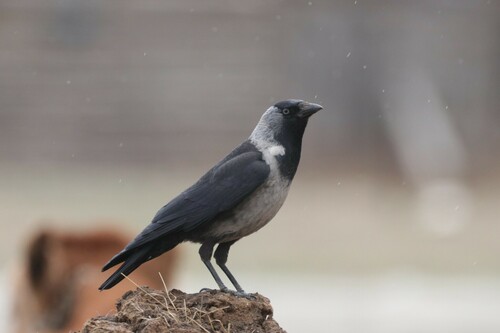
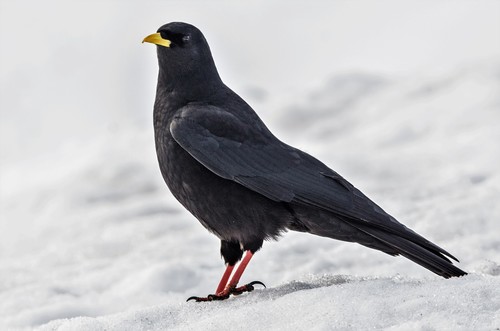
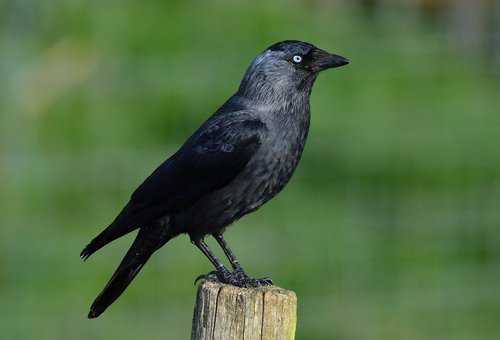
Coloeus monedula (Linnaeus, 1758), commonly called the western jackdaw, measures 34–39 centimetres (13–15 in) in length and weighs around 240 grams (8.5 oz). Most of its plumage is shiny black. Subspecies monedula and spermologus have a purple sheen on the crown, forehead, and secondaries, while subspecies cirtensis and soemmerringii have a blue sheen in these areas; all populations have a green-blue sheen on the throat, primaries, and tail. The cheeks, nape, and neck are light grey to greyish-silver, and the underparts are slate-grey. Both legs and the short stout bill are black; the bill is about 75% the length of the rest of the head. Rictal bristles cover around 40% of the maxilla and 25% of the lower mandible. Adult western jackdaws have greyish or silvery white irises, while juveniles have light blue irises that turn brownish before whitening at around one year of age. The sexes look similar, though the head and neck plumage of males fades more with age and wear, especially just before moulting. Western jackdaws undergo a complete moult from June to September in the western parts of their range, and one month later in the east. The purplish sheen of the cap is most prominent immediately after moulting. Immature birds have duller, less clearly demarcated plumage: their head is sooty black, sometimes with a faint greenish sheen and visible brown feather bases; the back and side of the neck are dark grey, and the underparts are greyish or sooty black. Their tail has narrower feathers and a greenish sheen. There is very little geographic variation in size. The main differences between populations are the presence or absence of a partial whitish collar at the base of the nape, plus variation in nape colour and the tone of the underparts. Central Asian populations have slightly larger wings, while western populations have slightly heavier bills. Body colour becomes darker in mountain regions and humid climates further north, and paler in other locations. Individual variation, especially in juveniles and in the months before moulting, often exceeds geographic differences. The western jackdaw is a skilled flyer capable of tight manoeuvres, tumbling, and gliding. It has distinctive jerky wingbeats when flying, which are not apparent during migration. Wind tunnel experiments show that its preferred gliding speed is between 6 and 11 metres (20 and 36 ft) per second, and wingspan decreases as the bird flies faster. On the ground, western jackdaws hold an upright posture and strut briskly; their short legs give them a rapid gait. They feed with their heads held down or horizontally. Within its range, the western jackdaw is unmistakable; its short bill and grey nape are distinguishing features. From a distance, it can be confused with the rook (Corvus frugilegus), or when in flight, with a pigeon or chough. In flight, western jackdaws can be told apart from other corvids by their smaller size, faster and deeper wingbeats, and proportionately narrower, less fingered wing tips. They also have shorter, thicker necks, much shorter bills, and frequently fly in tighter flocks. They can be distinguished from choughs by their uniformly grey underwings and black beaks and legs. The western jackdaw is very similar in morphology, behaviour, and calls to the Daurian jackdaw, whose range overlaps with the western jackdaw in western Asia. Adults are easily distinguished, as the Daurian jackdaw has pied plumage, but immature birds are much more similar, with both species having dark plumage and dark eyes. The Daurian jackdaw tends to be darker, with a less contrasting nape than the western jackdaw. The western jackdaw is found from Northwest Africa through all of Europe except the subarctic north, eastwards through central Asia to the eastern Himalayas and Lake Baikal. To the east, it occurs throughout Turkey, the Caucasus, Iran, Iraq, Afghanistan, Pakistan, and northwestern India. It is regionally extinct in Malta and Tunisia. Its range is vast, with an estimated global extent between 1 and 10 million square kilometres (0.4–4 million square miles). It has a large global population, with an estimated 15.6 to 45 million individuals in Europe alone. Censuses of bird populations in marginal uplands in Great Britain show that western jackdaw numbers increased greatly between the 1970s and 2010, though this increase may be related to recovery from previous periods when the species was regarded as a pest. The UK population was estimated at 2.5 million individuals in 1998, up from 780,000 in 1970. Most populations are resident, but northern and eastern populations are more migratory, relocating to wintering areas between September and November and returning between February and early May. Their range expands northwards into Russia to Siberia during summer and retracts in winter. They are vagrants to the Faroe Islands, particularly in winter and spring, and occasionally to Iceland. Elsewhere, western jackdaws congregate over winter in the Ural Valley in northwestern Kazakhstan, the northern Caspian, and the Tian Shan region of western China. They are winter visitors to the Quetta Valley in western Pakistan, and winter vagrants to Lebanon, where they were first recorded in 1962. In Syria, they are winter vagrants and rare residents, with some confirmed breeding recorded. Subspecies soemmerringii occurs in south-central Siberia and extreme northwestern China and is accidental to Hokkaido, Japan. A small number of western jackdaws reached northeastern North America in the 1980s and have been found from Atlantic Canada to Pennsylvania. They have also occurred as vagrants in Gibraltar, Mauritania, and Saint Pierre and Miquelon, and one individual has been reported in Egypt. Western jackdaws inhabit wooded steppes, pastures, cultivated land, coastal cliffs, and towns. They thrive when forested areas are cleared and converted to fields and open areas. They prefer habitats with a mix of large trees, buildings, and open ground; open areas are generally used by rooks, and more heavily wooded areas by the Eurasian jay (Garrulus glandarius). Along with other corvids such as the rook, common raven (Corvus corax), and hooded crow (C. cornix), some western jackdaws spend the winter in urban parks. Population measurements from three urban parks in Warsaw show numbers increase from October to December, possibly due to western jackdaws migrating there from areas further north. Data from Warsaw collected from 1977 to 2003 showed the wintering western jackdaw population increased four-fold over that period. The cause of this increase is unknown, but a local reduction in the number of rooks may have benefited the species, or rooks overwintering in Belarus may have caused western jackdaws to relocate to Warsaw.