About Collybia zonata (Peck) Sacc.
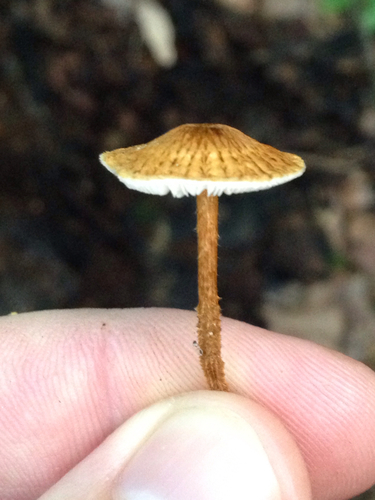
This species, originally published under the scientific name Collybia zonata (Peck) Sacc., is currently classified as Crinipellis zonata, a small brown mushroom. Its cap ranges from 1 to 2.5 cm (0.4 to 1.0 in) in diameter, and is convex in shape, sometimes becoming nearly flat. Most specimens have a small, distinctive depression at the cap center; the entire cap surface is densely hairy and dry, and often shows concentric zones of differing color and texture. The cap itself is tawny or cream, while its linearly arranged surface hairs are tawny. The white gills are narrow, closely spaced, and free or nearly free from attachment to the stem; they do not discolor over time. The stem measures 25 to 50 mm (1.0 to 2.0 in) tall by 1 to 2 mm (0.04 to 0.08 in) thick. Like the cap, the stem is densely covered in tawny hairs; the stem is hollow, while the cap holds only an insubstantial layer of white flesh. The spore print is white. Spores are smooth, elliptical, and measure 4–6 by 3–5 μm. Spore-bearing cells called basidia are four-spored, club-shaped, and measure 25–30 by 6.0–6.5 μm. The hymenium contains basidioles, which are basidium-shaped cells that lack the slender sterigmata that attach spores to basidia; these basidioles measure 15–28 by 3.0–8.0 μm, and range in shape from club-shaped to cylindrical to fusoid (fuse-shaped). Cheilocystidia, cystidia located on gill edges, measure 20–45 by 5.0–9.0 μm, are cylindrical, club-shaped or fusoid, often irregular, and may be branched or coral-like. Pleurocystidia, cystidia located on the gill face, are absent. The hairs on the cap surface measure about 50–800 by 4.0–10 μm, are roughly cylindrical with an irregular base, and stem hairs have a similar structure. Both cap and stem hairs are dextrinoid, meaning they stain yellowish-brown or reddish-brown when exposed to iodine in Melzer's reagent. Clamp connections are present in all fungal tissues. Crinipellis zonata is a saprobic species that grows on hardwood debris or roots, and produces wood-decaying enzymes that can break down the polycyclic aromatic hydrocarbon pyrene. Mushrooms grow individually or in small clusters, and fruit between August and September. It is distributed east of the Rocky Mountains in North America, with recorded occurrences as far west as Indiana and Texas. It has also been collected in Portugal (Europe) and South Korea.