About Collybia tuberosa (Bull.) P.Kumm.
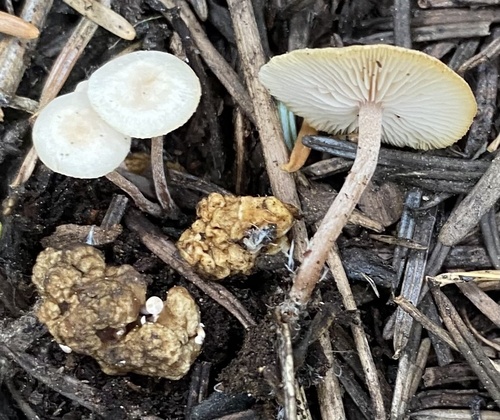
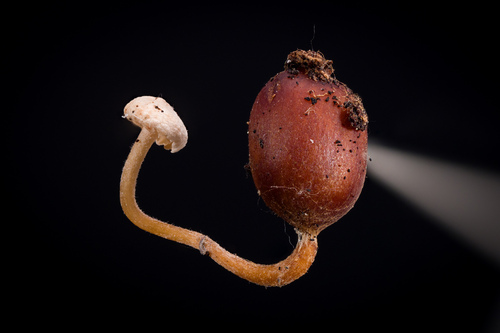
Collybia tuberosa (Bull.) P.Kumm. has a cap that changes shape with age: it starts obtusely convex to cushion-shaped with an inward-curved margin when young, becoming flattened with age, where the margin curves downward or is straight. The cap sometimes has a shallow central depression or a shallow umbo. It is small, reaching a maximum diameter of 10 mm (0.39 in). The cap surface is dry to moist, smooth to covered in fine soft hairs, and somewhat hygrophanous, meaning its color changes depending on hydration level. Occasionally, the cap margin is pleated or grooved. The center of the cap is pinkish-buff, while the margin is whitish; the entire cap becomes whitish as it matures. The flesh is thin, colored whitish to light buff. The mushroom has no distinctive taste or odor; it is considered inedible but nonpoisonous. The gills are adnate (bluntly fused to the stem), becoming subdecurrent with age (running slightly down the length of the stem). Gill spacing ranges from close to subdistant. Individual gills are whitish to pinkish-buff, thin, narrow to moderately broad, and have straight edges. The stem measures 10–50 mm (0.4–2.0 in) long by 1–2 mm (0.04–0.08 in) wide, and is roughly equal in width along its entire length. It is slender and thread-like, flexible and pliant, with a dry surface. The top of the stem is covered with scales or a fine whitish powder, while the lower portion has delicate to coarse hairs. Stem color is generally whitish to pinkish-buff, but darkens after handling. The stem interior is pithy, and becomes hollow with age. Stems grow from a dark reddish-brown sclerotium of variable shape, typically measuring 3–12 mm (0.12–0.47 in) by 2–5 mm (0.08–0.20 in). The sclerotium surface is initially smooth, but becomes wrinkled or furrowed over time; its interior is solid and white. It is often compared to an apple seed in appearance. Typically, several sclerotia are connected by thin strands of mycelia. The sclerotium is a resting structure that allows the fungus to overwinter in its host. In 1915, William Murrill reported that the sclerotia of C. tuberosa are bioluminescent. The spore print is white. Individual spores are smooth, ellipsoid to tear-shaped in profile, and obovoid to ellipsoid or cylindric in face or back view, with dimensions of 4.2–6.2 by 2.8–3.5 μm. They are inamyloid and acyanophilous, meaning they do not react to staining with Melzer's reagent and Methyl blue, respectively. The basidia, which are the spore-bearing cells in the hymenium, are club-shaped to cylindric, and measure 15.4–21 by 3.5–5 μm. Cheilocystidia, cystidia located on the gill edge, are scattered to infrequent, inconspicuous, and 17.5–31.5 μm long. Their shape ranges from a contorted cylinder to roughly club-shaped to irregularly diverticulate, with short offshoots approximately at right angles to the main cell body. There are no pleurocystidia, cystidia on the gill face. Gill tissue is made of interwoven hyphae that do not react to Melzer's reagent. These hyphae are smooth and thin-walled, measuring 2.8–6.4 μm in diameter. Cap tissue is made of interwoven hyphae below the cap center, radially oriented hyphae over the gills, and all cap tissue hyphae are inamyloid. These hyphae are smooth, thin-walled, and 2.8–7 μm in diameter. The cap cuticle is a thin layer of smooth thin-walled hyphae that are more or less radially oriented, bent-over, cylindric and somewhat gelatinous, measuring 2–5 μm in diameter; they are occasionally diverticulate. The stem cuticle is made of a layer of parallel, vertically oriented smooth, thin-walled hyphae that are 2–4.2 μm in diameter, and pale yellowish brown in alkali mounting solution. The stem has moderately thin-walled and smooth cystidia that resemble flexuous or contorted cylinders. They are hyaline in alkali, and 3.5–7 μm in diameter. Clamp connections are present in the hyphae of all tissues. A 2023 chemical analysis found that this mushroom contains 49 mg/kg of the mycotoxin muscarine. It is not known if C. tuberosa is strictly parasitic (requiring a living host) or saprobic. Either way, the fungus' fruit bodies grow either solitarily or in dense clusters on the decomposing, often blackened remains of other mushrooms. Known hosts include agarics (particularly Lactarius and Russula), boletes, hydnums, and polypores. In the Pacific Northwest region of the United States, Russula crassotunicata is a common and abundant species definitively identified as a host for both C. tuberosa and Dendrocollybia racemosa. Russula fruit bodies decay slowly, and are available nearly year-round as a substrate for these saprobes. Based on field observations, authors suggest C. tuberosa may produce fruit bodies on less decayed mushrooms, while D. racemosa produces fruit bodies on much more heavily decayed mushrooms. Collybia tuberosa is found in Europe, North America, and Japan. It is most common in the summer and autumn, which coincides with the fruiting periods of other mushrooms.