About Collybia cirrhata (Schumach.) Quél.
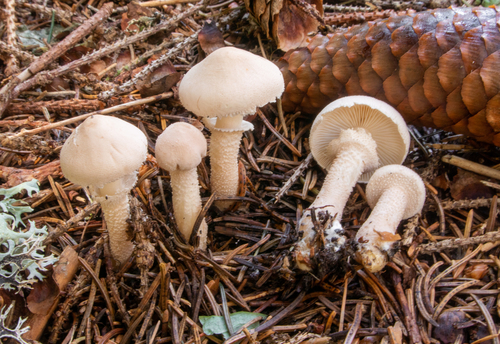
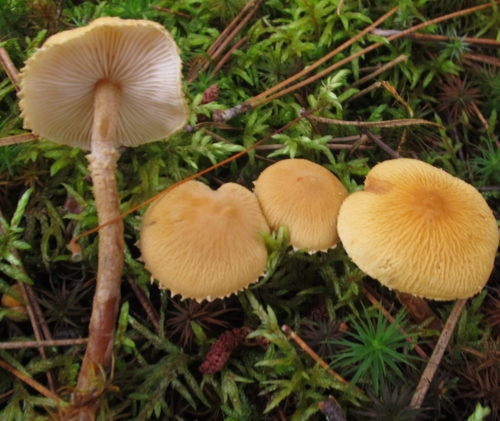
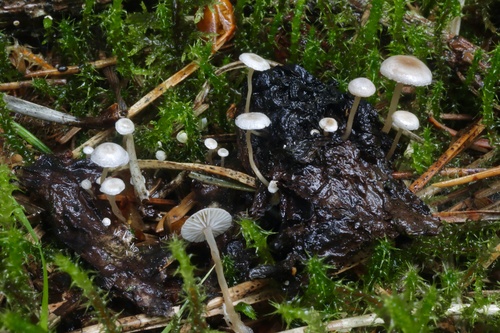
Collybia cirrhata (Schumach.) Quél. has a cap that starts convex when young, and matures to become convex, flattened, or slightly depressed in the center, reaching a diameter of 3–11 mm (1⁄8–3⁄8 in). When young, the cap margin is rolled or curved inward, and straightens as the mushroom matures. The cap surface ranges from dry to moist, can be smooth to covered with fine whitish hairs, is mostly even, and has translucent radial grooves at the margin. It is subhygrophanous, meaning its color changes somewhat depending on hydration: it becomes grayish-orange when watery or old, and is usually white with a very faint pinkish flush when fresh. The flesh is whitish, quite thin, and has no distinctive taste or odor. The gills are adnate to slightly arcuate (curved bow-shaped) with a tooth: the gills curve up to join the stem, then the gill edge curves down again very close to the stem. There are 12 to 20 full gills that extend completely from the cap edge to the stem, plus 3 to 5 tiers of shorter lamellulae that do not reach fully from the cap edge to the stem. The gills are thin, narrow to moderately broad, and colored white to pinkish-buff. Gill edges are even, and match the color of the gill faces. The stem measures 8–25 mm (3⁄8–1 in) long and up to 2 mm (1⁄16 in) thick; it is equal in width from top to bottom, or slightly enlarged toward the base. It is flexible and filamentous, but not fragile. The stem surface is dry, colored whitish to grayish-orange, and sometimes has tiny hairs on the upper portion that become coarser near the base. The stem base often bears rhizomorph-like strands or copious whitish mycelia. Unlike the other two species in the genus Collybia, stems of C. cirrhata do not grow from a sclerotium. The stem becomes hollow as it matures. C. cirrhata is too small and insubstantial to be considered edible. For microscopic characteristics: spore deposits are white. Individual spores are ellipsoid to tear-shaped in profile, and obovoid to ellipsoid or roughly cylindrical when viewed from the face or back. Spore dimensions are 4.8–6.4 by 2–2.8 μm, sometimes reaching up to 3.5 μm. Spores are smooth, inamyloid, and acyanophilous, meaning they do not react to staining with Melzer's reagent and methyl blue, respectively. The basidia, the spore-bearing cells of the hymenium, are roughly club-shaped, four-spored, and measure 17.5–21 by 4.8–5.6 μm. The gills do not have cystidia. Gill tissue is made of interwoven to roughly parallel, inamyloid hyphae. These hyphae are 2.8–8.4 μm in diameter and smooth. Cap tissue is made of interwoven hyphae beneath the cap center, and radially oriented hyphae over the gills; cap tissue is also inamyloid. Cap tissue hyphae are 3.5–8.4 μm in diameter, smooth, and have irregularly thickened walls. The cap cuticle is an ixocutis: a gelatinized layer of hyphae lying parallel to the cap surface. The hyphae that make up this layer are 2.8–6.4 μm in diameter, smooth, and thin-walled, and are covered with scattered, short pouch-like outgrowths. The stem cuticle is a layer of parallel, vertically oriented hyphae that measure 3.5–4.2 μm. These hyphae are smooth, slightly thick-walled, and pale yellowish-brown in alkaline solution. They give rise to a covering of tangled, branched, multi-septate caulocystidia (cystidia growing on the stem). The caulocystidia are 2.8–4.8 μm in diameter, smooth, thin-walled, and shaped like contorted cylinders. Clamp connections are present in the hyphae of all tissues. Like all species currently retained in the genus Collybia, C. cirrhata is saprobic. It typically grows on the decaying or blackened remains of other mushrooms; occasionally fruit bodies grow on moss or soil with no apparent connection to decaying mushrooms, though these instances may involve host tissue that has decayed enough to remain only as buried fragments in the substrate, often from a previous growing season. Known host fungi include Lactarius, Russula, Meripilus giganteus, and Bovista dermoxantha. Collybia cirrhata occurs in temperate, boreal, alpine, and arctic habitats. The fungus is widespread across Europe, including Bulgaria, Denmark, Germany, Greece, Latvia, Scandinavia, Slovakia, Switzerland, Turkey, and the United Kingdom. It is also common in the northern montane regions of North America. In Asia, it has been reported in Korea and Hokkaido, northern Japan. It is also known from Greenland. A 2009 publication proposed that based on available evidence, the species may have a circumboreal distribution.