About Collinsia verna Nutt.
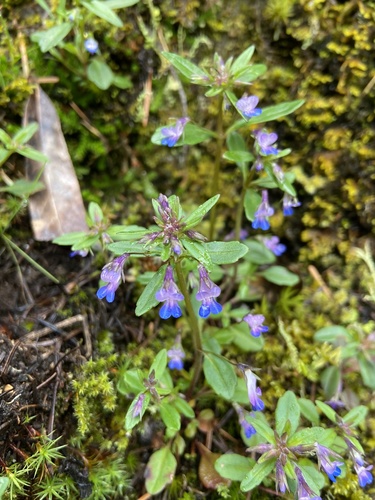
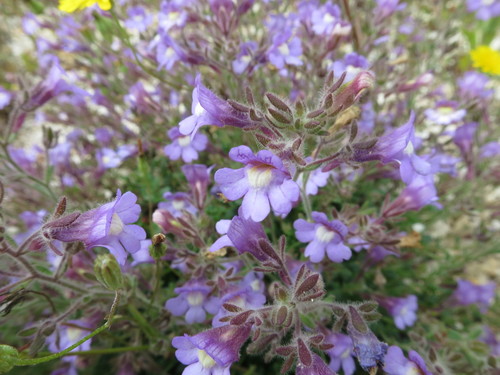
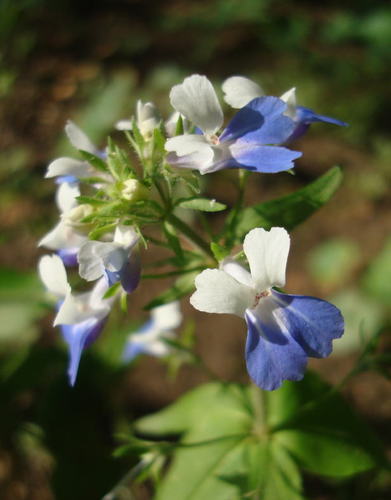
Collinsia verna Nutt. is an herbaceous plant. Individual plants typically grow 4 to 12 inches (10–30 cm) tall. Its leaves are arranged oppositely on the stem, growing up to 2 inches long and ¾ inch across. Leaf color ranges from medium green to yellowish green; leaves are either glabrous or pubescent, and are most commonly pubescent. The largest leaves are the middle stem leaves, which are oval to broadly lanceolate, usually have a few blunt edges along their margins, and grow with sessile bases or bases that clasp the stem. Flowers sometimes develop from the axils of upper leaves, and these axillary flowers have slender pedicels that reach up to 1½ inches long. Each flower measures ½ to ¾ inch across, formed of a green calyx with 5 teeth and a blue-and-white corolla. The calyx itself ranges from light green to purplish green. The corolla is divided into an upper lip and a lower lip. The upper lip is split into two large rounded white lobes, while the lower lip is split into three lobes. The two large outer lobes of the lower lip are light blue to blue-violet, and the tiny middle lobe of the lower lip is folded into a keel and hidden from view. This species has a slender taproot as its root system.
Collinsia verna is native to eastern North America. Its native range extends from Ontario and New York south to Virginia, southwest to Tennessee and Oklahoma, and north to Kansas, Iowa, and Wisconsin, and it also occurs across many other eastern U.S. states.
This species most often grows in damp open woods, as it requires ample shade. It prefers moist to mesic conditions and rich loamy soil, because moisture level and soil richness strongly influence the growth and final size of individual plants. Seeds must be planted in summer to germinate in fall. It can also thrive in wooded lower slopes of river valleys and along woodland paths. Occasionally, this species (commonly called Blue-Eyed Mary) grows in drier deciduous woodlands, but individual plants in these habitats are smaller than average.
Collinsia verna reproduces via both self-pollination and outcrossing. It produces delayed selfing through changes in the receptivity timing and position of its stigma and anthers. A 1999 study by Susan Kalisz found that in 70% of flowers, the stigma moves to the front of the keel and positions itself near the anthers when the third anther dehisces. Under field conditions, fruiting success of plants kept in pollinator exclosures (allowing only autogamy) reached 75% of the fruiting success of open-pollinated plants: 33% fruiting success via autogamy, compared to 44% for open-pollinated plants. The study concluded that autogamy occurs late in floral development, which increases this species' potential for reproductive assurance, and that individual flowers vary in their ability to set fruit through this mechanism.