About Coleus amboinicus Lour.
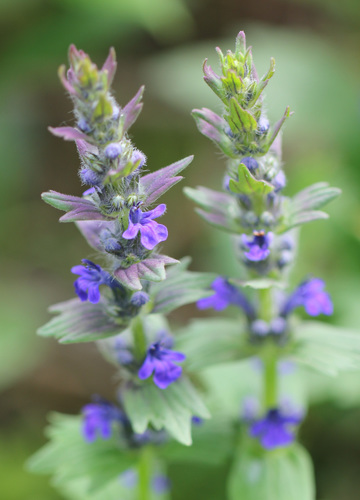
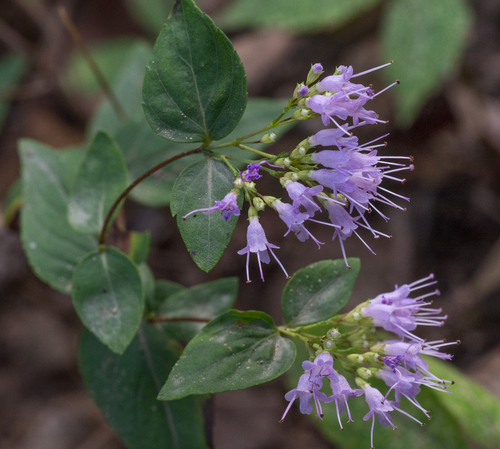
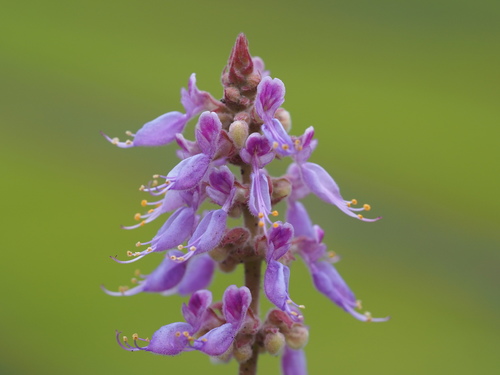
Coleus amboinicus Lour. is a member of the mint family Lamiaceae, growing up to 1 meter (3.3 feet) tall. Its stems are fleshy, 30–90 cm (12–35 in) long, and covered in either long rigid hairs (hispidly villous) or dense, short erect soft hairs (tomentose); older stems become smooth (glabrescent). The leaves are 5–7 cm (2.0–2.8 in) by 4–6 cm (1.6–2.4 in), fleshy, simple (undivided), broad, and ovate (egg/oval-shaped with a tapering tip). Except at the base, leaf margins are coarsely crenate to dentate-crenate. Leaves are thickly covered in hairs (pubescent), with the most numerous glandular hairs on the lower surface that give a frosted appearance. Leaf petioles measure 2–4.5 cm (0.79–1.77 in) long. The leaf aroma is a pungent combination of oregano, thyme, and turpentine, and the leaf taste is similar to oregano with a sharp mint-like flavor. Flowers are shortly pedicelled (borne on short stems), pale purplish, and arranged in dense 10-20 (or more) flowered whorled cymes. These cymes are spaced at distant intervals along a long, slender, spike-like raceme. The raceme rachis is 10–20 cm (3.9–7.9 in) long, fleshy, and pubescent. Bracts are broadly ovate, 3–4 cm (1.2–1.6 in) long, and acute-tipped. The calyx is campanulate (bell-shaped), 2–4 mm (0.079–0.157 in) long, hirsute and glandular, with five subequal teeth: the upper tooth is broadly ovate-oblong, obtuse with an abrupt acute point, while the lateral and lower teeth are acute. The corolla is blue, curved and declinate, 8–12 mm (0.31–0.47 in) long, with a 3–4 mm (0.12–0.16 in) long tube that widens into a trumpet shape. The corolla limb is two-lipped: the upper lip is short, erect, and finely pubescent, while the lower lip is long and concave. Filaments are fused below into a tube that surrounds the style. The seeds (nutlets) are smooth, pale-brown, roundish and flattened, approximately 0.7 by 0.5 mm (0.028 by 0.020 in) in size. This species is native to Southern and Eastern Africa (ranging from KwaZulu-Natal, South Africa and Eswatini to Angola and Mozambique, and north to Kenya and Tanzania), the Arabian Peninsula, and India. It grows in woodland or coastal bush, on rocky slopes, and on loamy or sandy flats at low elevations. It was later introduced to Europe, then brought from Spain to the Americas, which gave it the common name Spanish thyme. The strongly flavored leaves of this herb are used as an oregano substitute to mask strong odors and flavors of fish, mutton, and goat. Leaves may be batter-fried to make pakodas, or added to rasam. In the Caribbean, leaves are commonly used to season meats for their pungent aroma. Fresh leaves are used to scent laundry and hair, and the plant is also grown as an ornamental. Coleus amboinicus is a fast-growing plant commonly cultivated in gardens and grown indoors in pots. It can be propagated by stem cuttings, and can also be grown from seed. In dry climates, it grows easily in well-drained soil in a semi-shaded position. It is frost tender, suited to USDA hardiness zones 10–11, and grows well in subtropical and tropical locations. In cooler climates, it can be grown successfully in a pot if brought indoors or moved to a warm, sheltered location over winter. In humid tropical locations such as Hawaii, the plant requires full sun. It can be harvested throughout the growing season for use fresh, dried, or frozen.