About Colchicum alpinum DC.
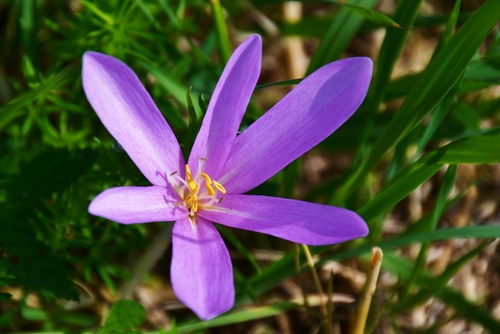
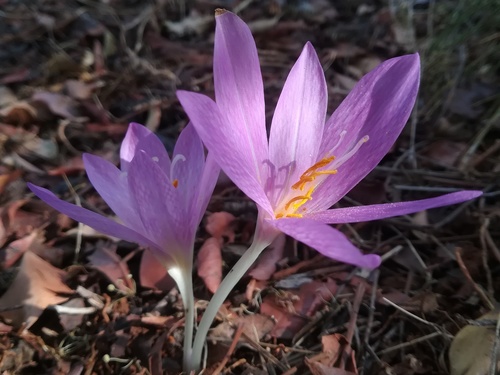
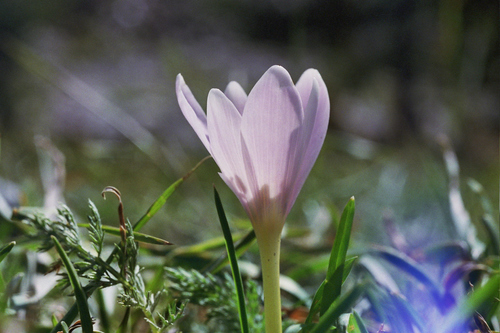
Colchicum alpinum DC., commonly known as the alpine autumn crocus, is a corm-forming perennial plant that produces pale, delicate rosy-purple flowers. It is similar in appearance to Colchicum autumnale, but has smaller overall size. It is native to the Alps and Apennines of Italy, Switzerland, France, and Sicily, and is grown as an ornamental plant in other regions. In Sardinia, Colchicum alpinum grows throughout the island's interior highlands. Confirmed populations are found at Ortakis, which is its type locality, the Supramonte of Orgosolo, Monte Albo, the Mandas–Marghine region, and other upland sites. These populations grow on both calcareous outcrops, such as those at Ortakis and Monte Albo, and siliceous terrains, such as at Supramonte d'Otulu, which shows the species has ecological flexibility across different substrate types. Colchicum alpinum grows from underground corms, which are swollen storage organs that reach up to approximately 40 × 30 mm in size. Each late summer, the plant emerges from its corm to produce flowers, with no leaves present when flowers first appear. Flowers open in August, then wither, and capsules do not develop until the following year. The flowers have four outer tepals that are 30–50 mm long, and are rarely shorter than 30 mm. Tepals are borne atop scapes that are covered by 4–6 leaves. In the spring after flowering, a rosette of new leaves unfurls, and the already formed fruit capsules mature by early summer. This pattern of flowering in one year and fruiting in the next forms a biennial life cycle that distinguishes Colchicum alpinum from its close relative Colchicum autumnale, which typically flowers and fruits within the same growing season. Under certain conditions, especially at lower elevations or when grown in milder climates, some individual plants may complete both flowering and fruiting in a single year, or even produce leaves at the same time as flowers. Transplant experiments have shown that extending the length of the growing season can shift Colchicum alpinum to an annual cycle more similar to that of Colchicum autumnale, which demonstrates that environmental factors influence the species' phenology.