About Coix lacryma-jobi L.
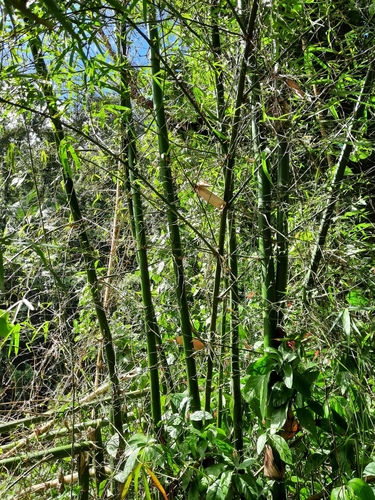
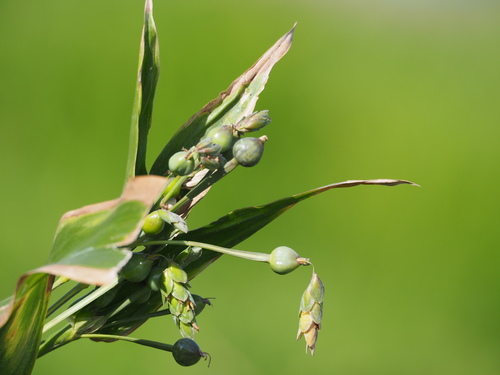
Coix lacryma-jobi L., commonly known as Job's tear, is a robust, monoecious broad-leaved grass with a loose, branched growth habit. It reaches heights between 1.20 meters and 1.80 meters. Like all species in the Coix genus, its inflorescences develop from the leaf sheath at the end of the stem, and include hard, globular or oval, hollow, bead-like structures. Job's tear seeds vary in color: soft-shelled seeds are typically light brown, while hard-shelled forms have a dark red pericarp. The hardened structures that cover the seeds are technically the fruit-case or involucre, which is a hardened bract; some earlier botanical works refer to this bract as "capsule-spathe" or "sheathing bract". These shells cover the bases of the plant's male and female inflorescences, which are racemes or panicles. Male racemes grow upright and are made of overlapping scale-like spikelets, with yellow stamens protruding between them. One or two yarn-like stigmas hang downward from the base of the inflorescence structure. Throughout East Asia, dried Job's tears are sold and cooked as a grain, and are widely eaten as a cereal. Cultivated varieties are soft-shelled and can be easily cooked into foods like gruel. Among the Zomi people of Southeast Asia, an annual Job's tears festival called the miim festival is held to honor departed souls. Some soft-shelled types are easily threshed, producing sweet kernels. Threshed and polished kernels, called ren in Chinese (薏苡仁; pinyin: yiyi ren; Wade–Giles: i i jen), are used in traditional Chinese medicine. Threshed Job's tear grains are generally spherical, with a groove on one end, and are polished white when prepared this way. In Japan, unpolished grains are also sold, marketed as yūki hatomugi, or organic Job's tears. In Cambodia, where the plant is known as skuay (ស្គួយ), its seeds are not commonly used as a grain, but are instead used in herbal medicine and as an ingredient in desserts. In Thailand, it is often used to make teas and other drinks, such as soy milk. In Northeastern India, it is grown as a minor cereal crop and used for fodder. Job's tear grains can be used the same way as rice. They can be eaten cooked or even raw, with a slightly sweet taste. Grains can also be processed into flour, and can be milled using the same equipment used for rice. For soft hulls, pressing them over a sieve is sufficient processing. Unlike rice, Job's tear grains do not require polishing, a process that causes rice to lose vitamins. This makes Job's tear a valuable food source for undernourished populations in rural areas. Job's tears is used alongside other herbs in traditional Chinese medicine and folk medicine. The plant is mentioned in the ancient Chinese medical text Huangdi Neijing (dated to the 5th–2nd centuries BCE), which is attributed to the legendary Huangdi, the Yellow Emperor. It did not gain inclusion in the standard traditional Chinese materia medica reference Bencao Gangmu (本草綱目), compiled in the 16th century. For cultivation management, when seedlings have grown 3–4 true leaves, growers should adjust the number of seedlings per planting hole, leaving 2–3 healthy, well-grown plants in each hole. At least three tillage sessions are required over the entire crop growth period. The first tillage is carried out when seedlings are 5–10 cm high, and involves weeding to promote tillering. The second tillage is done when seedlings reach 15–20 cm high. The third tillage is completed when seedlings are 30 cm high, and is combined with fertilizer application and soil cultivation to encourage root growth and prevent the plants from lodging (collapsing).