About Coffea arabica L.
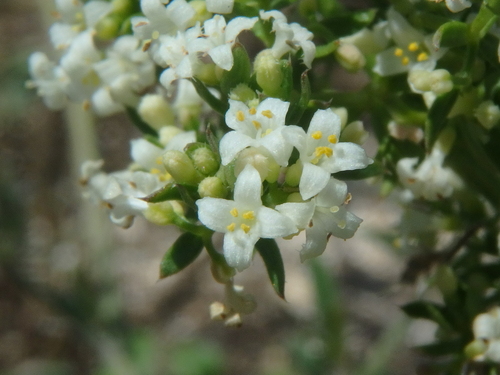
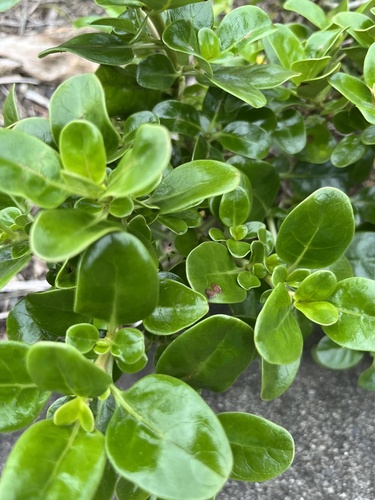
Coffea arabica L. Wild individuals of this species grow 9 to 12 meters (30 to 39 feet) tall, with an open branching structure. Its leaves are opposite, simple, and elliptic-ovate to oblong, measuring 6–12 cm (2.5–4.5 in) long and 4–8 cm (1.5–3 in) broad. The leaves are glossy dark green, with prominent veins and wavy margins. The species produces white flowers 10–15 mm in diameter, which grow in axillary clusters of 2 to 9. Its seeds are held inside a 10–15 mm diameter drupe commonly called a "cherry". The drupe matures to a bright red to purple color, and typically contains two seeds, which are known as coffee beans.
This species is endemic to the southwestern highlands of Ethiopia, and has also been found growing naturally on the Boma Plateau in South Sudan. It also occurs on Mount Marsabit in northern Kenya, though recent studies support that this population is naturalized rather than truly native. Coffea arabica is cultivated in dozens of countries located between the Tropic of Capricorn and the Tropic of Cancer, where it is commonly grown as an understory shrub. It has become widely naturalized outside its native range, across many parts of Africa, Latin America, Southeast Asia, India, China, and various islands in the Caribbean and Pacific.
Coffea arabica was first introduced to Hawaii in 1813, and became extensively established in cultivation by around 1850. It was formerly more widely grown in Hawaii, especially in the Kona region, and persists in many areas after cultivation ended. In some Hawaiian valleys, it grows as a highly invasive weed. It is also a problematic invasive species in the Udawattakele and Gannoruwa Forest Reserves near Kandy, Sri Lanka. Commercial coffee production of this species began in Queensland and New South Wales, Australia, during the 1980s and 1990s. The Wet Tropics Management Authority has classified Coffea arabica as an environmental weed for southeast Queensland due to its invasiveness in non-agricultural areas.
Coffea arabica accounts for 60% of global coffee production. It takes approximately seven years for the plant to reach full maturity. It grows best with 1.0–1.5 meters (39–59 in) of evenly distributed annual rainfall. It is usually cultivated at altitudes between 1,300 and 1,500 m (4,300 and 4,900 ft), though plantations grow it as low as sea level and as high as 2,800 m (9,200 ft). The plant can tolerate cool temperatures, but cannot survive frost, and grows best with an average annual temperature between 15 and 24 °C (59 and 75 °F). Most commercial cultivars only reach around 5 m tall, and are frequently trimmed to as low as 2 m to make harvesting easier. Unlike Coffea canephora, C. arabica prefers to grow in light shade.
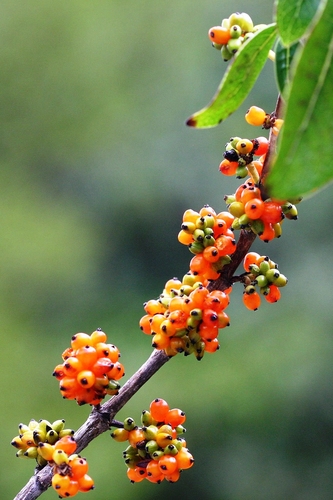
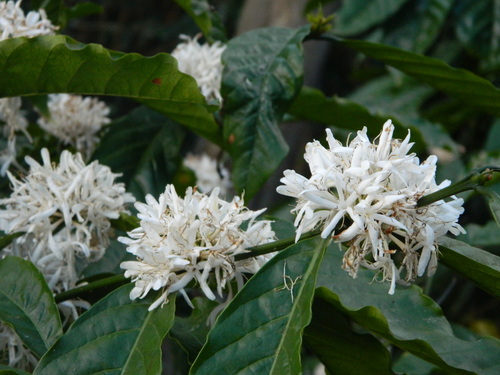
Two to four years after planting, C. arabica produces small, white, highly fragrant flowers. The sweet scent of these flowers resembles the fragrance of jasmine. More berries develop from flowers that open on sunny days. This can be problematic, because coffee plants often produce too many berries, which leads to an inferior harvest and can even damage yields in the following years: the plant prioritizes berry ripening at the cost of its own overall health. On well-maintained plantations, overflowering is prevented by pruning. The flowers only last a few days, leaving only the plant's thick, dark green leaves behind, after which berries begin to develop. Young berries are the same dark green as the plant's foliage; as they ripen they turn yellow, then light red, and finally darken to a glossy deep red. At this fully ripe stage, the fruit is called a "cherry" because it resembles that fruit, and it is ready for picking. Ripe berries are oblong and around 1 cm long. Picking berries too early or too late produces inferior coffee, so berries are often picked by hand to select only fully ripe fruit, since they do not all ripen at the same time. Berries are sometimes shaken from the tree onto collecting mats, which results in a mix of ripe and unripe berries.
Coffea arabica trees are difficult to cultivate, and each tree produces between 0.5 and 5.0 kilograms (1.1 and 11.0 lb) of dried beans, depending on the individual tree's characteristics and the season's climate. The beans inside the fruit are the most valuable part of this cash crop. Each berry holds two locules, each containing one bean; coffee beans are the two seeds inside the fruit. Occasionally, a single seed called a peaberry, or more rarely a third seed, grows in the fruit at the tips of branches. These seeds are covered by two membranes: an outer membrane called the "parchment coat" and an inner membrane called the "silver skin".
On Java, trees are planted at all times of year and harvested year-round. In parts of Brazil, by contrast, the trees have a single growing season and are only harvested in winter. The plants are vulnerable to damage in poor growing conditions such as cold temperatures or low pH soil, and are also more vulnerable to pests than Coffea robusta plants. IPCC modelling projects that medium-term depletion of indigenous C. arabica populations may occur due to global warming. Rising temperatures, longer droughts, and excessive rainfall driven by climate change threaten the sustainability of arabica coffee production, which has spurred efforts to breed new cultivars adapted to changing conditions.
Gourmet coffees are almost exclusively made from high-quality mild varieties of arabica coffee. Some of the best known arabica coffee beans in the world come from Jamaican Blue Mountain, Colombian Supremo, Tarrazú (Costa Rica), Guatemalan Antigua, and Ethiopian Sidamo. Blends made only of arabica are often labelled "100% Arabica" as an indicator of quality. In 2023, several large coffee roasters removed the "100% Arabica" declaration from some of their product packaging and began blending less expensive Robusta coffee into their products. To avoid making major changes to the packaging's visual design, the Arabica label was replaced with other labeling while keeping the original ornamental design, an example of shrinkflation. As of 2024, some roasters still advertise these products as "100% Arabica" in promotional flyers, even though the claim no longer appears on the actual product packaging.