About Coereba flaveola (Linnaeus, 1758)
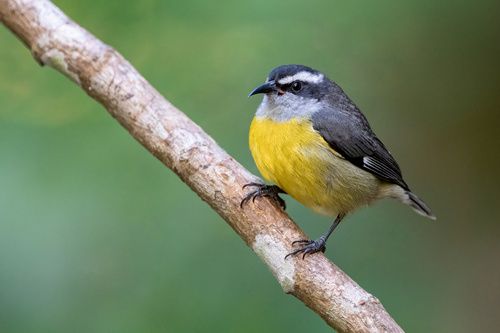
Coereba flaveola (Linnaeus, 1758), commonly called the bananaquit, is a small bird with notable size variation across its subspecies. It ranges from 10 to 13 cm (3.9 to 5.1 in) in length, and weighs 5.5 to 19 g (0.19 to 0.67 oz). For most subspecies, plumage features dark grey (almost black) upperparts, black crowns and head sides, a prominent white eyestripe, a grey throat, white vent, and yellow chest, belly, and rump. This species' coloration is heavily shaped by variation in the melanocortin 1 receptor. Male and female bananaquits look identical, while juvenile birds have duller plumage and often have partially yellow eyebrows and throats. Different island subspecies have distinct plumage traits: the bahamensis (Bahamas) and caboti (Cozumel) subspecies have white or very pale grey throats and upper chests; the ferryi subspecies from La Tortuga Island has a white forehead; the laurae, lowii, and melanornis subspecies from small islands off northern Venezuela's coast are overall blackish; and the aterrima (Grenada) and atrata (Saint Vincent) subspecies have two plumage morphs, one typical and one blackish. Subspecies from Caribbean Sea islands usually have a very prominent pink gape. The bananaquit has a paddle-shaped tongue with an extremely long paddle section. This species is a year-round resident across tropical South America, ranging north to southern Mexico and the Caribbean. It occurs throughout the West Indies except for Cuba, and birds from the Bahamas are rare visitors to Florida. It occupies a wide range of open to semi-open habitats, including gardens and parks, but it is rare or absent from deserts, dense forests such as large areas of the Amazon rainforest, and areas at altitudes above 2,000 m (6,600 ft). Nests built by bananaquits are known to be used by frog species including the Common coquí. In terms of behaviour and ecology, the bananaquit has a slender, curved bill adapted to obtain nectar from flowers, including mistletoe flowers. Nectivory is thought to be an independent evolutionary innovation in the genus Coereba. After this trait evolved, the bananaquit's tongue shape underwent convergent evolution with other birds that feed on the same flowers, and the flowers the bananaquit visits have also evolved convergently to accommodate its tongue. The bananaquit sometimes acts as a nectar robber, piercing flowers from the side to take nectar without pollinating the plant. It also feeds on fruit, including mistletoe fruits, other berries, and ripe bananas — this fruit feeding habit gives the species its common name, and gives the Hispaniolan subspecies its scientific epithet bananivora. It obtains sweet juice from fruit by puncturing it with its beak, and will occasionally eat small insects such as ants and flies, insect larvae, and other small arthropods such as spiders. Unlike hummingbirds, the bananaquit cannot hover, so it must always perch while feeding. The bananaquit is well known for its ability to adapt well to human-altered environments. It often visits gardens and may become very tame. Its nickname "sugar bird" comes from its attraction to bowls or bird feeders filled with granular sugar, which is a common method people use to attract these birds. The bananaquit builds a spherical lined nest with a side entrance hole, and lays up to three eggs that are incubated only by the female. It may also build nests in human-made objects such as lampshades and garden trellises. Bananaquits breed year-round regardless of season, and build new nests throughout the year.